GAMBLING DISORDER
MENTAL HEALTH AND ADDICTION PROVIDERS
Problem Gambling is the Elephant in the Room.
Let's talk about it.
It’s not just the gambler with the problem who’s at risk. Families suffer in silence, often too ashamed to confront the elephant in the room. For every gambler, eight to ten others experience gambling-related harms.
Mental health and addiction providers should have a strong understanding of gambling disorders. More than 250,000 Minnesotans experience mild to severe problem gambling, which often co-occurs with mental health and substance use disorder. Screening for gambling-related harm and making appropriate referrals can help ensure clients receive timely and effective support.
Gambling Disorder Referrals
If you need to refer a client to a gambling treatment professional in Minnesota, call 1-800-333-HOPE (4763). Translation services are available.
If you notice signs of problematic gambling, contact an approved provider to arrange a full screening. When treatment is recommended, work with the counselor to develop a coordinated plan that addresses gambling concerns along with any co-occurring mental health or substance use issues. In most cases, gambling treatment is available at no cost to the client.

Telehealth sessions are available, and any Minnesotan can access counseling services from an approved provider via video or phone. Treatment is free for individuals without private insurance or those with high deductibles. Family counseling is also available, even if the person experiencing gambling harm is not seeking treatment.
Help is Available, Often at No Cost
Most Minnesotans with a gambling disorder, along with affected family members, can access treatment—often at no cost through the state. The Minnesota Department of Human Services oversees the gambling treatment program.
If a client you are treating for other mental health or substance use concerns is interested in gambling treatment and has little or no insurance coverage, counseling is typically covered when they see a state-approved provider. Family members may also receive up to 12 hours of counseling per year at no cost if they are uninsured.
Order Brochures
SELF-HELP PUBLICATIONS
View, download or order a hard copy below (These are meant to be supplemental guides, not a replacement for therapy)
- Your First Step to Change, 2nd Edition. A self-help toolkit of resources to help start the journey toward recovery from problem gambling behavior.
Brochures
- Warning Signs of Problem Gambling (English, Spanish, Chinese, Hmong and Vietnamese)
- What Families Can Do When a Loved One has a Gambling Problem (English and Spanish)
- What is Problem Gambling? (English and Spanish)
- Gambling When in Recovery (English and Spanish)
- Gaming Disorder (English and Spanish)
- Gamban—Block Access to Your Devices (English and Spanish)
- Older Adults and Gambling. When is it a Concern?
- Youth and Gambling
- Lower Risk Gambling Guidelines
- Talking to Your Child About Gaming
(English, Spanish, Chinese, Hmong, Lao and Vietnamese)
Brochures for Professionals
- Be Part of the Solution (English and Spanish)
- Why Screen for Gambling Disorder? (English and Spanish)
Newsletter
- Northern Lights - MNAPG Quarterly Newsletter
Interested in receiving copies of our literature?


LEARN HOW
Two voluntary, self-exclusion tools for online gambling sites.
Given that many gamblers may be moving online, MNAPG is offering individual subscriptions for an online self-exclusion tool called Gamban. This tool enables the gambler to block tens of thousands of online gambling sites on all devices. MNAPG has purchased one-year subscriptions that can block up to 15 devices in one household.
If you are interested, please email sstucker@mnapg.org and a link will be provided to set up the account.
BetBlocker helps you, or those you care about, ensure that they can manage their access to gambling in a safe and appropriate manner. Whether that means restricting altogether, or limiting during periods of vulnerability, BetBlocker can help. Visit https://www.betblocker.org to download this free app.
GAMBLING DISORDER – THE HIDDEN ADDICTION
Gambling disorder, gambling addiction, is often referred as the “hidden addiction” because it has no visible symptoms, such as those associated with drug or substance use disorder. It’s an addiction that impacts over two million Americans.
Gambling Disorder as Defined in DSM-5
According to DSM-5 diagnostic criteria, gambling disorder is defined as persistent and recurrent problematic gambling behavior leading to clinically significant impairment or distress. An individual with gambling disorder exhibits four or more of the behaviors listed in the DSM-5 over the course of a 12-month period.
Gambling for longer periods of time than originally planned
Bragging about wins, but not talking about losses

Increased frequency of gambling activity
Denying there is a problem
Lying about how money is spent
Pressuring others for money when financial problems arise
Escaping to other excesses (alcohol, drugs, sleep, video games, etc.)

A Resource You Can Share
When someone is experiencing gambling-related concerns, knowing where to turn for help can be difficult. Evive provides an accessible, digital starting point for people who may be questioning their gambling, looking to make a change or struggling with gambling-related harm.
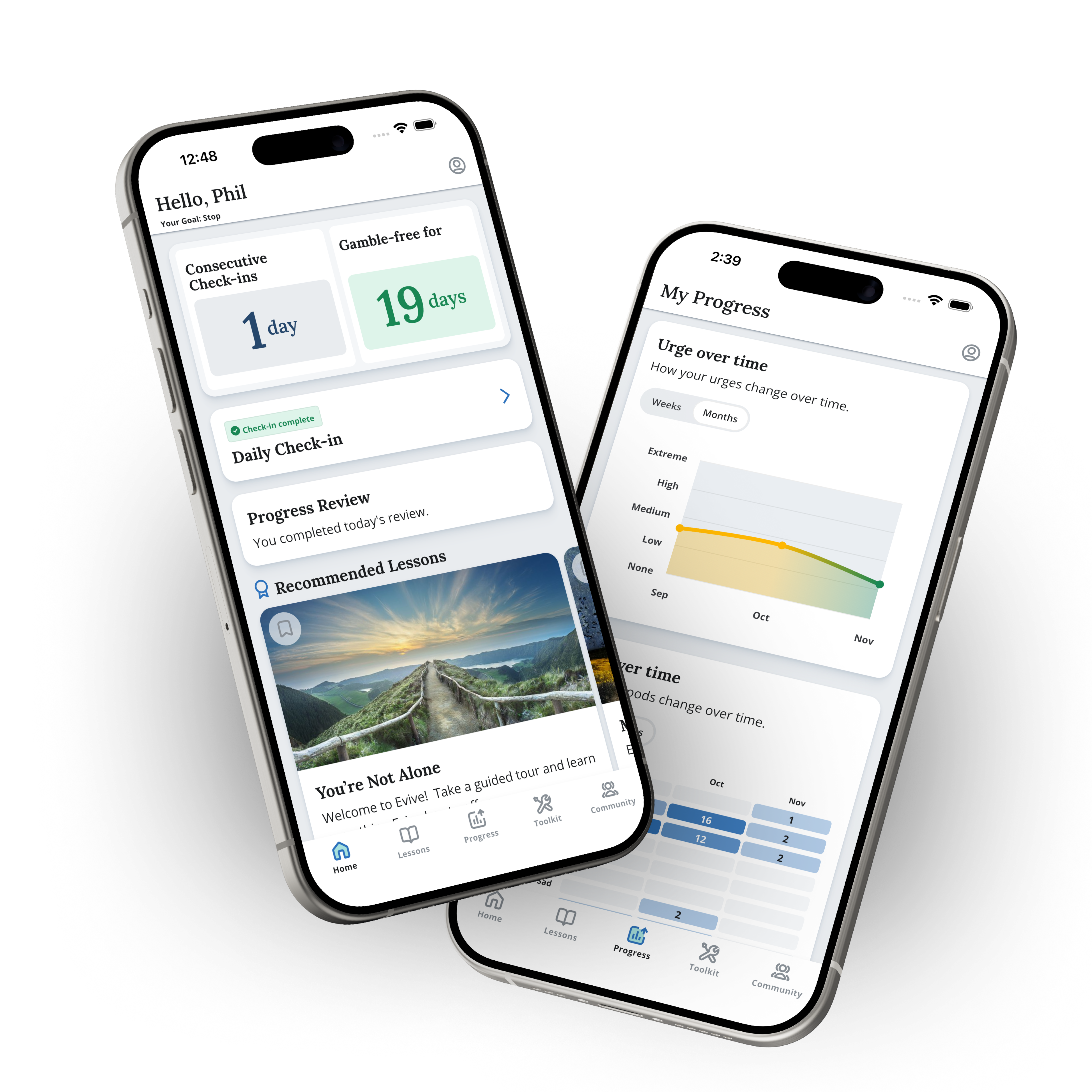
Evive is a free, evidence-informed app that provides personalized tools, education and community support for people across the spectrum of gambling behavior. Users can choose whether their goal is to manage their gambling or stop altogether, and the app adapts to their goals and needs.

Check-Ins
Daily check-ins that help users become more aware of their emotions, behaviors and gambling patterns.

Tools
Practical tools for managing urges, stress and other challenges associated with gambling.

Education
Evidence-informed education developed with gambling and behavioral health experts.
Community
Peer community support where users can connect with others who have experienced gambling-related harm.
Resources
Connections to additional resources, including professional support and community services.
Help Someone Take the First Step
If you work with patients, clients, students, employees or young adults who may be experiencing gambling-related concerns, share Evive as a resource they can access anytime, privately and at their own pace.
Share Evive Today

SCREENING FOR A GAMBLING DISORDER
Screening, as a part of intake or later assessments, can help your client on their overall recovery by uncovering a gambling disorder. Unless you ask specifically about gambling, the individual is not likely to mention it or perhaps even make the connection.
Knowing you may have limited time, using the Brief Bio Gambling Screening can provide a quick indication of a possible gambling disorder. This consists of the following three questions:
1. During the past 12 months, have you become restless, irritable or anxious when trying to stop/cut down on gambling?
2. During the past 12 months, have you tried to keep your family or friends from knowing how much you gambled?
3. During the past 12 months, did you have such financial trouble as a result of your gambling that you had to get help with living expenses from family, friends or welfare?
If your client answers yes to any of the questions, it doesn’t mean they have a gambling addiction, but it’s worth having more conversation.

MNAPG NORMATIVE FEEDBACK TOOL
This is a survey in which your client will be asked a series of questions relating to their gambling preferences and their attitudes towards gambling. As they answer the questions, they will see how other Minnesotans have replied. At the completion of the survey, they’ll receive a report letting them know where they fall on the problem gambling spectrum. You can check out the survey yourself by clicking here.
GAMBLING DISORDER SCREENING TOOL KIT
MNAPG wants to encourage all who deal with clients with addiction and/or mental health issues to screen for problem gambling. Over 67% of those with gambling issues have a co-occurring issue. The screening kit offers a variety of resources in case your client answers yes to any one of the three questions. Early detection may minimize the harms that come with excessive gambling. Find it here.
Some helpful information about gambling disorder and its relationship to substance abuse:
- The rate of current and lifetime substance abuse is higher among problem gamblers than that of the general population.
- Higher rates and severity of substance use are predictive of more severe gambling problems and vice versa.
- The greater the number of substances used the more likely severe gambling problems are experienced.
- Those with problem gambling behavior often have increased impulsivity, antisocial tendencies and the inability to control anger.
- Gambling at an earlier age increases the risk for multiple addictions and risky behavior.
- Those with gambling problems and comorbid substance use may make poor decisions because of increased impulsivity.
- The inability to accurately assess risk and impaired impulse control often occurs with gambling and substance abuse orders.
- Higher rates of gambling relapse may occur when there is a failure to treat comorbid substance use disorders.
- People with comorbid substance use and gambling problems are more likely to report other psychiatric histories.
Some helpful information about gambling disorder and its relationship to mental health disorders:
- High rates of gambling are often associated with mental health problems. Most problem gamblers have more than one psychiatric disorder.
- While there is correlation between comorbid problem gambling and other mental disorders, a causative relationship has not yet been determined.
- The activity of gambling may relieve other conditions, such as anxiety and depression.
- The early onset of gambling addiction is often associated with pre-existing depression.
- Gambling may worsen mental disorders such as depression and anxiety.
- People who have major mental disorders and are socially isolated are most at risk for problem gambling.
- Behavioral and motivational treatment of problem gambling has been shown to reduce use of psychiatric medication, suggesting that anxiety and depression may be secondary to gambling, at least in some people.
- Women are more likely to use gambling to escape depressed moods and anxiety. Women with a gambling addiction are also significantly more likely to seek treatment for their mood or anxiety disorder.
- Mood disorders are more common in problem gamblers than they are in the general population.
- People with bipolar disorder are more likely to have a gambling addiction than the general population.
- There is a correlation between those with high rates of anxiety and those with more severe gambling problems.
- People with ADHD have increased rates of problem gambling.
- Problem gambling is highly correlated with a variety of personality disorders, including antisocial, borderline and obsessive-compulsive personality disorders.
- Impulse control disorders (including kleptomania, impulsive shopping and impulsive sexual behavior) and purging-type eating disorders have high comorbidity with problem gambling.
Are there medications that can help gambling disorder?
- There are no FDA-approved medications for the treatment of gambling disorder; however, several studies suggest that medications used to treat other addictive and psychiatric disorders may reduce problem gambling.
- Trials evaluating the effectiveness of antidepressants for treating disordered gambling have produced mixed results.
- Overall, the trials on several medications have had small sample sizes and been short in duration. Thus, more research is needed.
- Suicidal thoughts and suicide attempts are much more likely to occur with problem gamblers than with the general population.
- Early onset problem gambling is associated with increased risk of suicide.
- Actual gambling-related suicide attempts are more likely to be made by older people.
- The risk of suicide in people with gambling problems is increased by comorbid substance use and comorbid mental disorders.
- Gamblers have the highest rate of suicide among all addictions.
- There is a greater risk of suicide among veteran/active military who have gambling disorders.
We encourage providers to become members of both MNAPG and the National Council on Problem Gambling (NCPG). This is a great way to stay informed about problem gambling developments in Minnesota and at the federal level. As a member, you can:
- Attend monthly NCPG webinars for free
- Receive discounts for conferences
- Be eligible for MNAPG scholarships to attend the national conference, and
- Lend support to both organizations at the state and federal levels
INSPIRING SUCCESS STORIES
You and your clients should know that treatment has helped improve the lives of many Minnesotans with a gambling problem. We have a trove of stories reflecting this success.

In Their Own Words – Tim’s Story
Winning $500 at the age of 7 started “Tim” on a life of gambling. It took him half a lifetime to get control of his addiction. READ MORE

In Their Own Words — Cal’s Story
The roots of a gambling addiction can begin in childhood, especially when a parent is a gambler. READ MORE

In Their Own Words – Sandra Kaye’s Story
Gambling drove her to the brink of suicide but her gambling support group provided a bond that changed her life forever. READ MORE
View or Request
Read
Research
Access problem gambling research