Dec 17, 2025 | ABOUT MNAPG, ADVOCACY, PROFESSIONALS, YOUTH GAMBLING
MNAPG attended two conferences in October: the mid-year Indian Gaming Association (IGA) conference and the International Center for Responsible Gaming (ICRG) conference. Here are some takeaways.
Indian Gaming Association Conference
At the IGA, the focus was on the growing concern about prediction markets and casino sweepstakes—and the impact these unregulated, untaxed platforms could have on tribal revenues. Legalized gambling, whether you agree with it or not, has allowed Minnesota tribal nations to expand and diversify their economies and provide a wide range of services to their communities. These market disrupters are viewed as existential threats to tribal sustainability and independence. (Editor’s note: As of November 5, 2025, the Minnesota Attorney General’s office sent cease-and-desist letters to 14 illegal gambling operators—sports betting and casino sweepstakes.)
The American Gaming Association also recognizes the threats these new platforms pose—not only to gambling revenue but also to consumer protection. Our current federal anti-regulatory environment could significantly change how people engage with gambling. By redefining gambling as a commodity and placing it under the Commodity Futures Trading Commission (CFTC), these platforms may create a stronger illusion of control—skill rather than luck. This illusion is a common fallacy among gamblers, especially sports bettors. Mislabeling gambling products as “trading” blurs the line between investing and gambling, putting consumers at risk. The way these platforms target young adults is particularly troubling. They are designed for continuous, habit-forming engagement, with no guardrails or risk warnings.
The discussions were sobering and, for MNAPG, highlighted yet another area where we need to pay close attention and raise awareness within the community and among policymakers.
International Center for Responsible Gaming Conference
The ICRG conference, a day and a half of research reveals, provided an opportunity to hear firsthand the latest findings in responsible gambling, explore emerging tools and regulatory practices, and discuss the growing integration of responsible gambling principles into the broader gambling landscape. While much work remains, I’m encouraged by the shift among some operators to place greater emphasis on consumer protection. Our advocacy efforts at the national and state levels are having a positive impact, and we need to continue being the thorn in operators’ sides.
One session examined the connection between gambling literacy and financial literacy and the need to evolve both so that users understand how risky behaviors can develop through new mediums like digital finance, investment platforms and social media.
Another session focused on artificial intelligence and emphasized that AI should amplify human insight, not replace it. Advances in AI may eventually enhance early risk detection and enable personalized responsible gambling interventions—but only if we eliminate bias and uphold the highest standards of privacy protection.
Finally, researchers studying youth emphasized the need to create relatable prevention materials and deliver them in the spaces where young people actually spend their time, rather than where we think they should be. They also highlighted the importance of developing prevention programs that account for gender, age and cultural identity.
Jun 18, 2025 | PROFESSIONALS
The International Gambling Counselor Certification Board (IGCCB) changed its name to the International Problem Gambling and Gaming Certification Organization (IPGGC) in December 2024 to better reflect its expanded mission and scope. This rebranding acknowledges the growing convergence between gambling and gaming behaviors and the need for specialized training and certification in both areas.
The organization, established in 1984, initially focused solely on gambling-related certifications. However, with the recognition of gaming disorder by the World Health Organization and the increasing prevalence of gaming-related issues, the IPGGC now offers certifications that encompass both gambling and gaming disorders. These include the International Certified Gambling Counselor (ICGC) credentials and the International Gaming Disorder Certificate (IGDC), among others.
By updating its name, the IPGGC aims to provide clearer guidance to professionals and the public, ensuring that those affected by gambling and gaming disorders receive support from certified experts trained in current best practices across both domains.
Aug 7, 2024 | PROFESSIONALS, RESEARCH
Read the original article on The BASIS Here.
By John Slabczynski
Despite rising popularity, gambling remains a risky behavior that costs the U.S. an estimated $14 billion annually. One reason these costs are so high is because of the pervasiveness of gambling harms. Like other addictive behaviors, harms from gambling can stretch across multiple domains including social, occupational, health, financial, and even criminal. To minimize gambling harms, it is necessary to identify gamblers who might benefit from self-help tools or professional support, ideally before they experience severe consequences. One available screening tool is the Gambling Harms Scale 10 (GHS-10). One potential weakness of the GHS-10 is that it asks respondents to report whether they’re experiencing each harm using a simple “yes or no” format, rather than allowing them to report on how severely they’re experiencing a given harm. A person’s score is simply the total number of harms they’re experiencing. This week, The WAGER reviews a study by Philip Newall and colleagues that explored the validity of this measure by studying the lived experiences of gamblers in Australia with different levels of problem gambling severity according to the GHS-10.
What was the research question?
Is the GHS-10 a valid gambling harm screener, in that the lived experiences of gamblers relate in a logical way to their scores on the GHS-10?
What did the researchers do?
The researchers re-contacted a sample of 30 individuals from a previous study. These participants were recruited based on problem gambling severity according to scores on the GHS-10 from the previous study. Additionally, all participants were age 18 or older and had reported gambling within the past year. The research team then conducted semi-structured interviews with participants to elicit information about the role that gambling has played in their lives, including positive and negative experiences and harms to themselves and society more generally. The researchers grouped participants according to their GHS-10 scores (no-harm = 0 harms, low-harm = 1-2 harms, moderate-harm = 3-5 harms, and high-harm = 6-10 harms). Then they explored whether those with higher scores described having more severe negative experiences with gambling. This would support the idea that the GHS-10 is a valid measure.
What did they find?
Qualitative perceptions of gambling and experiences of harms were strongly related to participants’ GHS-10 scores (Figure shows themes and selected responses). For example, participants in the no-harm category described gambling as similar to any other leisure activity, with one participant describing the financial impact as the same as “collecting stamps”. In support of the GHS-10’s validity, as GHS-10 scores increased, so too did the propensity for financial harms. At the low-harm level, financial impacts were within reason but could veer towards regrettable. Participants in the moderate harm category occasionally experienced severe financial harms and participants in the high-harm category described significant financial harms. Interestingly, many other themes were present at multiple levels of problem gambling severity (e.g., gambling to build relationships) albeit with some adverse consequences or risk as problem gambling severity increased.

Figure: Displays the subthemes identified by the research team at each level of problem gambling severity, according to the GHS-10. A selected quote is shown under each subtheme that represents one participant’s understanding of each subtheme.
Why do these findings matter?
These findings are important because they provide more evidence for the utility of gambling harm screens, and the GHS-10 in particular. Specifically, this study showed that even without inquiring about the severity of gambling problems, the GHS-10 is able to discriminate between severe and less severe cases. Researchers should consider using this type of mixed methods approach that includes both quantitative and qualitative elements when studying gambling, as it can provide a more holistic view to better understand lived experiences.
Every study has limitations. What are the limitations in this study?
The researchers note that their background as gambling addiction researchers (and beyond that the developers of the GHS-10) might have biased their interpretations of participants’ qualitative responses. Additionally, though the overall sample contained 30 participants, no group of participants (i.e., across the no-harm, low-harm, moderate-harm, and high-harm gamblers groups) included more than eight participants, limiting the generalizability of this study.
May 23, 2024 | ABOUT MNAPG, PROBLEM GAMBLING, PROFESSIONALS, RESOURCES
Minnesota Conference
The Minnesota Conference on Problem Gambling takes place on Thursday, Sept. 19 at the Hilton Minneapolis/Bloomington. While we’re still finalizing the day’s sessions, here are some topics we plan to cover:
- The intersection of gambling and suicide
- Financial counseling for families
- The impact of gambling on families
- Community leader panel discussion about gambling
- Update on sports betting legislation
- National gambling attitudes survey results
Please check mnapg.org in the coming months for additional information about the conference as we solidify the agenda.
National Conference
The National Conference on Gambling Addiction & Responsible Gambling takes place in San Diego on July 17-19. The conference brings together world-class presenters to deliver powerful and insightful messages about problem gambling and responsible gambling. For more information and to register, visit ncpgconference.org.
May 17, 2024 | PROFESSIONALS, RESEARCH
Read the original article on The BASIS Here.
By John Slabczynski
Due to the recent proliferation of new investing applications , more laypeople are engaging in retail stock market trading. Though some people have profited from this activity, many others have experienced significant harms. For example, in one high profile case, a young retail trader died by suicide because he (mistakenly) believed he suffered a huge trading loss. Several interested parties have also raised concerns around the gamification of the stock market, especially in brokerage apps like Robinhood, combined with the rapid pace of today’s retail trading, which calls to mind casino gambling. To prevent harm, it is important to understand specific mechanisms driving harms from investing. Therefore, this week, The WAGER reviews a study by Leonardo Weiss-Cohen and colleagues that examined how problem gambling severity and market volatility influenced trading intensity.
What were the research questions?
(1) Does problem gambling severity relate to trading intensity? (2) Does volatility in the market affect trading intensity?
What did the researchers do?
The research team invited 604 participants from an online survey panel to complete a simulated trading task. All reported both gambling in the past year and having lifetime experience buying a financial asset like a stock or bond. The researchers formed four semi-equally sized groups based on their scores on the Problem Gambling Severity Index (PGSI); 1) recreational/no-risk gamblers, 2) low-risk gamblers, 3) medium-risk gamblers, and finally, 4) high-risk gamblers. In the trading task, each participant received a startup fund and had the opportunity to invest in six fictitious stocks on a computerized trading platform. Participants were randomly assigned to one of two conditions, one with high volatility (i.e., stock prices moving up and down frequently) and one with low volatility. The research team manipulated the stocks in both conditions so that they would both have the same overall return (i.e., potential profit), albeit with significantly more volatility in the high volatility condition. To better replicate real-world behavior, participants received financial bonuses based on the results of their trading, with better performance resulting in higher bonuses. The researchers studied how problem gambling severity related to the intensity with which participants made stock trades, and whether participants traded more intensely when faced with high market volatility.
What did they find?
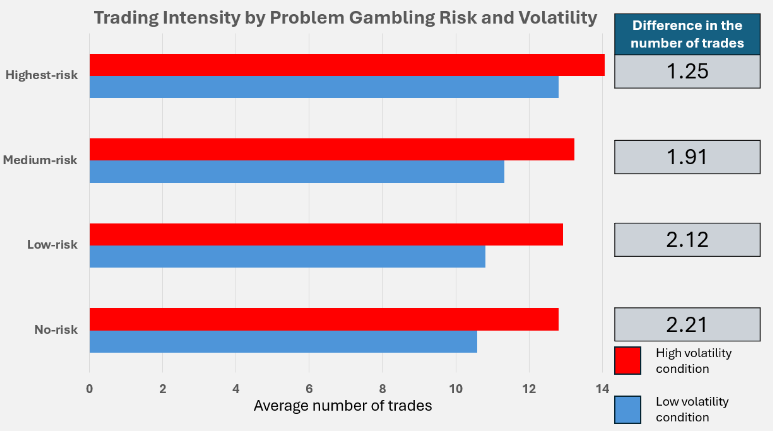
Contrary with other research, participants with more severe problem gambling did not trade more intensely. However, volatility did shape trading intensity; participants in the high volatility condition made 17% more trades compared to participants in the low volatility condition. This effect remained regardless of problem gambling severity and while controlling for financial literacy, overconfidence, age, and gender. Interestingly, exploratory analyses suggested that problem gambling severity may play a moderating role in predicting trading frequency, but only outside the highest levels of risk. Specifically, in all four of the gambling groups, participants in the high volatility condition traded more intensely than those in the low volatility condition; however, this difference was especially apparent in the three lowest-risk groups (see Figure).
Figure. Displays the mean number of trades for each PGSI category between conditions from exploratory analyses. The boxes on the right represent the average difference between participants in the high volatility vs. low volatility conditions for each level of PGSI severity.
Why do these findings matter?
These findings are important for two reasons. Namely, they suggest that volatile assets such as cryptocurrencies or high-risk stocks (e.g., penny stocks) encourage more intense, gambling-like trading than less volatile assets mutual or index funds. This suggests that the gamification of brokerage apps like Robinhood and Webull may be putting more users at risk than was initially expected. Additionally, because the effects of volatility were strongest among no-risk participants, messaging efforts should potentially target lower-risk traders and gamblers as well. Often, outreach messaging focuses on those most at-risk in the population, yet this study suggests that those at lower-risk might actually be experiencing more harms from trading.
Every study has limitations. What are the limitations in this study?
This study occurred in a simulated environment in which participants did not trade with their own personal money, so the external validity of this study is in question. Additionally, compared to the average online brokerage account, this study provided relatively modest amounts of capital to trade with. It is quite likely that higher stakes with more money could influence the results of this study, possibly by encouraging more risky trading.
For more information:
Individuals who are struggling with problem gambling may find support through Gamblers Anonymous. They offer in-person and virtual meetings. Others who are concerned about their trading or gambling behavior may benefit from visiting the website for The National Council for Problem Gambling. Additional resources can be found at the BASIS Addiction Resources page.
—John Slabczynski
Mar 15, 2024 | PROFESSIONALS
The need to ensure there’s an adequate number of gambling treatment counselors in Minnesota is one thing. Ensuring that these counselors have the opportunity to collaborate and learn best practices to be successful is another
To ensure a level of quality control among counselors, MNAPG subsidizes a state-wide supervisory process whereby a certified gambling treatment counselor in one corner of the state can learn from a colleague in another part. Each month, providers have two opportunities to virtually meet one another and learn. “It’s a chance to network, connect, encourage and be a mentor for new people in the field,” says Lisa Vig Johnson, gambling addiction counselor at Lutheran Social Services of North Dakota who oversees the process.
“Newer providers need role models who can let them know about resources and tools to help them, such as videos, books, lectures or PowerPoint presentations” says Lisa. Seasoned providers can also help less experienced counselors with specific strategies and approaches when they encounter situations with clients that are challenging to treat effectively.
The provider convening also provides an opportunity to discuss ethical dilemmas that may arise during the course of treatment. “For example, there may be a situation where someone is coming to a provider but it’s not appropriate for them to provide services for legal or other reasons,” says Lisa. “In that case, we help direct them to the appropriate venue.”
In addition to being a place where gambling counselors can share their struggles and successes, the meetings provided a place for good old-fashioned bonding. “In the same way that people participating in treatment want to feel a sense of belonging and a place to share similar experiences, the same is true from a counseling perspective,” says Lisa. “It helps with morale and to keep each other engaged and dedicated even in the face of setbacks.”
Although the process is referred to as “provider supervision,” “supervision” is somewhat of a misnomer. “It has nothing to do with being “supervised” as an employee in the traditional context,” says Lisa. “It’s all about honing skills to be as effective a gambling counselor as possible.”
Currently, Minnesota does not mandate provider supervision. MNAPG believes this is an important component to the quality of care and therefore subsidizes this program. Provider supervision is voluntary and there is no cost for counselors or their organization to become involved. It’s a great opportunity for counselors to elevate their competencies, and ultimately provide Minnesotans struggling with gambling addiction the best possible outcome.
Page 1 of 812345...»Last »