Dec 17, 2025 | PROBLEM GAMBLING
Note: Much of the information included in this article is taken from a presentation by Glenn Yamagata, vice president of Data Science and Economic Analysis and senior consultant with Problem Gambling Solutions, Inc., executive director of the Oregon Council on Problem Gambling, and member of the National Council on Problem Gambling Board of Directors.
For many of us, digital assets, including cryptocurrencies, are something we’ve heard of but don’t fully understand. The same is true for Oregon Health Authority problem gambling treatment providers: 94% reported needing additional training to better address clients engaged in non-traditional forms of gambling, such as digital asset trading. Some providers indicated that as many as half of their clients are already involved in these activities. Therefore, developing a basic understanding of digital assets and how they function can be valuable, much like a therapist treating individuals who wager on sports benefits from knowing key sports betting terminology.
Common digital assets include e-books and digital art that are accessed online. However, the digital assets discussed in this article refer specifically to blockchain-enabled assets, such as cryptocurrencies. The blockchain is a type of electronic ledger with key features such as transparency, security and decentralization, which can be complex to understand. The essential point is that blockchain technology has made it possible to create new forms of digital assets that, in some cases, enable gambling-like behavior and may contribute to gambling problems for some individuals.
Cryptocurrencies
A cryptocurrency is a digital asset built on a blockchain, with the oldest, largest and most recognized example being Bitcoin. Some individuals engage in day trading or swing trading of cryptocurrency assets in ways similar to how they trade traditional assets such as stocks or bonds. However, cryptocurrency trading can be particularly addictive for several reasons.
- Trading hours:Unlike traditional financial markets, cryptocurrencies trade 24 hours a day, 7 days a week, 365 days a year. This constant availability creates endless opportunities to trade and can facilitate impulsive or compulsive behaviors.
- Market volatility: Cryptocurrencies often experience much greater price fluctuations than traditional assets, generating heightened excitement and anticipation among traders, which can reinforce risk-taking and reward-seeking behaviors.
- Speculative nature: High price volatility, limited fundamental valuations, regulatory uncertainty and the general characteristics of emerging markets make cryptocurrency trading more speculative and attractive to some individuals.
- Higher leverage: Cryptocurrency markets often allow for significantly higher leverage, sometimes 50 to 100 times the initial investment. This means individuals can amplify their gains (or losses) by a much greater multiple than is typically possible with traditional financial products.
Based on the Oregon Gambling Attitudes, Behaviors, Health and Risk Survey (2025), a report commissioned by the Oregon Council on Problem Gambling, adult Oregonians who engaged with cryptocurrencies were six times more likely to be classified as high risk for gambling disorder, as measured by the Problem Gambling Severity Index (PGSI).
Non-fungible tokens (NFTs)
Common NFTs include digital media such as music and visual art, where creators assign uniqueness to the work, similar to how a musician might sign an album cover or a photographer might add a personalized note to a print to make it one of a kind. This uniqueness increases the asset’s value, allowing it to be traded, as seen when the artist Beeple sold a digital collage of 5,000 individual artworks for $69 million at Christie’s Auction House in 2021.
NFTs are increasingly being introduced across a variety of asset forms and within gaming environments, creating new opportunities for speculative and gambling-like behavior. Some examples include:
- Gaming currency: NFTs are used as a means to make wagers in online casinos, replacing traditional methods such as credit cards and bank transfers. The advantages include player anonymity, low transaction fees and global accessibility without the need for fiat currency exchange.
- Prizes: NFTs can serve as prizes that have the potential to appreciate in value, making them especially attractive to players who see an opportunity for ongoing financial gain.
- Player-to-player payment option: NFTs have become a suitable payment method for transactions carried out between players; the transactions are viewed as safe, secure, anonymous and do not require a third party.
- Loyalty program awards: Online casinos use NFTs for customer acquisition and to incentivize loyalty. As unique digital assets, NFTs can serve as a differentiating factor that attracts and retains customers.
NFTs are connected to problem gambling behaviors through speculative activity, such as the short-term buying and selling of digital assets, and by enabling gambling-like ecosystems, including virtual casinos.
Decentralized finance (DeFi) applications
Decentralized finance (DeFi) applications are financial systems that enable individuals to transact directly with one another, without intermediaries such as banks. Many rely on self-executing “smart contracts,” in which financial terms are codified and stored on the blockchain.
DeFi platforms can foster gambling-like behavior by offering a highly speculative, largely unregulated environment that is easily accessible. They blend elements of cryptocurrency trading, prediction markets and gaming, blurring the line between investing and gambling.
Conclusion
The cryptocurrency, NFT and DeFi markets continue to grow rapidly. The cryptocurrency market alone is currently valued at around $3 trillion and is expected to expand significantly over the next decade. As these markets evolve, it is likely that more individuals will seek help from therapists for gambling-like addictions. Treatment providers would be well advised to develop at least a general understanding of these emerging platforms to better recognize and address the risks they pose.
Nov 26, 2025 | PROBLEM GAMBLING, YOUTH GAMBLING
Read the original article on the BASIS here.
By Kira Landauer, MPH
Livestreaming is a popular form of digital entertainment that allows viewers to watch content online as it happens live. Gambling livestreams are popular on platforms like Twitch and TikTok Live, where streamers broadcast themselves gambling with real money and in real time—playing games like online slots or placing sports bets. Audiences can watch the gameplay, listen to the streamer’s commentary, and interact directly with both the streamer and other viewers. What may seem like harmless fun could be problematic for some, with research linking gambling livestream viewership to future gambling intentions and problem gambling. This week, as part of our Special Series on Addiction and Technology, The WAGER reviews a study by Chelsea Hughes and colleagues that examined young adults’ experiences with and perceptions of gambling livestreaming.
What were the research questions?
(1) What motivates young adults to watch and engage with gambling livestreams? (2) How do they perceive their livestream viewing experiences?
What did the researchers do?
The researchers conducted semi-structured interviews with 15 young adults (ages 18 to 24) in the U.K. who regularly watched gambling livestreams (at least once a week) and had gambled in the past year. Participants described their reasons for watching, how they engaged with the livestreams, and their experiences as a viewer. Using thematic analysis, the researchers identified themes related to the meaning and value viewers attributed to their experiences.
What did they find?
The researchers identified three themes (see Figure).
- Social experiences and vicarious excitement describes the parasocial bonds viewers formed with streamers. Even as observers, viewers felt they were sharing in the streamer’s risk-taking and excitement, which created a sense of emotional connection. Many watched not only for gambling content but because they enjoyed the streamer’s personality.
- Interactivity and building loyalty highlights how livestream features—like gamified loyalty (earning points for engaging with the stream) and interactive prediction tools (wagering points on outcomes)—encouraged viewers to participate and feel more invested in the livestream’s outcomes.
- The urge and harm paradox reflects how participants viewed livestreams as a safer way to manage gambling urges, even though watching sometimes intensified those same urges. Some reported that watching livestreams contributed to an increase in their own gambling participation, despite recognizing the influence of streamers’ deceptive marketing tactics.
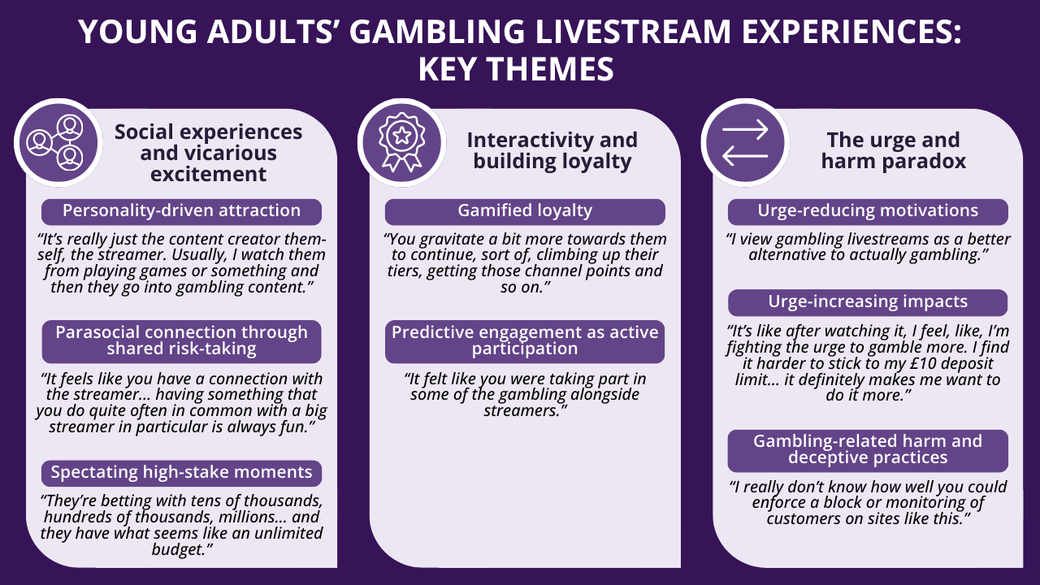
Figure. Key themes from young adults’ gambling livestream viewership, with quotes highlighting each subtheme. Click image to enlarge.
Why do these findings matter?
These findings show that young adults are drawn to gambling livestreams for various, often intertwined, reasons. Many viewers feel a personal connection to their favorite streamers. This sense of social connection and community is enhanced by interactive, gamified livestream features that encourage viewer engagement. These findings can inform regulatory policies intended to reduce potential harms. For example, streaming platforms might limit or ban gambling livestreams, or restrict gambling operators from advertising through streamers. The study also indicates that watching these streams is not a reliable way to manage gambling urges, and that for some viewers it may actually worsen cravings. Gambling treatment providers should be aware of gambling livestreams and factor the effects of watching and engaging in these streams into return-to-gambling prevention planning.
Every study has limitations. What are the limitations in this study?
More than half of the sample gambled frequently (20+ times in the past month) and were high-risk gamblers according to the Problem Gambling Severity Index. Therefore, these findings may not be generalizable to low-frequency or low-risk gamblers, or to contexts outside the U.K. where streaming culture, gambling culture, and regulations might differ. Finally, the study cannot determine the causal relationship between livestream viewership and gambling behavior.
Nov 26, 2025 | RECOVERY
Read the original post on the BASIS here.
By Tiange (Patrick) Xu, PhD
Editor’s note: This op-ed was prepared by Dr. Tiange (Patrick) Xu, a Postdoctoral Researcher at the International Gaming Institute, University of Nevada, Las Vegas (UNLV), specializing in problem gambling research. He earned his Ph.D. in Hospitality Administration from the William F. Harrah College of Hospitality at UNLV in 2025. His research portfolio encompasses systematic reviews, empirical studies on problem gambling, and policy-relevant investigations. He has received funding from the Nevada Council on Problem Gambling and the International Center for Responsible Gaming. His work has been published in journals such as the Journal of Behavioral Addictions, Addictive Behaviors, and Journal of Gambling Studies, and he currently serves as Associate Editor for the UNLV Gaming Research & Review Journal. This op-ed is part of our Special Series on Addiction and Technology, which was funded by a research and consulting contract with DraftKings.
Throughout 2021, rags-to-riches cryptocurrency stories dominated my social media feeds as Bitcoin climbed higher and higher. Everyone seemed to be getting rich while I sat on the sidelines. By November, when Bitcoin reached what was then its all-time high of $68,000, the fear of missing out became unbearable. I kept thinking about that programmer who spent 10,000 Bitcoins on two pizzas back in 2010, a purchase now worth over $1 billion. I didn’t want to be the person who looked back with regret. So I decided to enter the market and purchased Bitcoin for the first time.
I bought at the peak. Within two months, Bitcoin plunged below $40,000 and nearly half my investment vanished. The rational choice would have been to cut my losses, but instead I told myself I wasn’t a day trader chasing quick profits. I was a long-term investor who just needed patience. The crypto community had a term for this strategy: HODL, or hold on for dear life. I convinced myself that’s all I needed to do.
That’s when something unexpected started happening. I began checking the price obsessively, every morning over coffee, during lunch breaks, before bed, at 2 AM when I couldn’t sleep. My heart would race with each price notification. I wasn’t trading anything, just holding, but I had become completely consumed by watching those numbers change.
As a problem gambling researcher, I suddenly saw my own behavior through a different lens. I was experiencing the classic hallmarks of addiction: obsessive monitoring, emotional highs and lows tied to outcomes beyond my control, and the inability to stop despite knowing it had become unhealthy. I wasn’t gambling in the traditional sense, but the psychological experience was identical.
This recognition made me look more carefully at the cryptocurrency landscape around me. I began to see how the elements combined to encourage addictive engagement: markets operating around the clock with no closing bell, extreme volatility generating constant excitement, and a community culture that glorifies risk-taking behavior. I realized I needed to study this phenomenon systematically. My own experience had made me wonder whether this represented a public health blind spot: a large population engaging in potentially harmful behavior with no established framework for recognizing or addressing the risks.
But where to start? Given the psychological parallels between crypto trading and gambling, I decided to examine whether people drawn to cryptocurrency also struggle with gambling problems. I surveyed 700 cryptocurrency traders using the Problem Gambling Severity Index (PGSI), a validated screening tool for assessing gambling-related harm. The results were striking. Only one-third showed no signs of gambling problems. Another third were at risk, and the final third met criteria for problematic gambling. Two-thirds of cryptocurrency traders in my study were experiencing gambling-related harm at some level. This wasn’t a small vulnerable subset but the majority.
But I encountered a challenge in interpreting these findings. The screening tool I used was designed to assess problems with traditional gambling activities like slot machines. When participants answered questions like, “Have you felt that you might have a problem with gambling?” I couldn’t know whether they were thinking only about casino visits or whether some also included their cryptocurrency trading. Someone obsessively checking crypto prices at 2 AM might answer “yes” because they view their trading as gambling, while another person doing the exact same behavior might answer “no” because they see themselves as an investor. This ambiguity meant I couldn’t determine what I was actually measuring: traditional gambling problems among crypto traders, problematic trading behaviors that participants experience as gambling, or some combination of both.
This measurement challenge reflects a broader issue: our research frameworks haven’t kept pace with technologies that blur established categories. Cryptocurrency trading shares the psychological features of gambling but exists somewhere between gambling and investing, and our screening tools weren’t built for this ambiguous territory. Addressing this gap likely requires measuring these behaviors separately. When using traditional gambling screens like the PGSI, researchers could explicitly instruct participants not to include cryptocurrency trading in their responses. We also need screening instruments designed specifically for cryptocurrency trading. With both tools, we could then determine whether problematic trading and gambling are distinct issues that sometimes overlap, or whether they’re different expressions of the same underlying vulnerability.
My own Bitcoin still sits in my wallet today, a reminder of how easily harmful patterns can develop around cryptocurrency and how much work remains in understanding these risks.
Nov 19, 2025 | SPORTS BETTING, STORIES
By Saul Malek
Read the original article on the BASIS here.
Editor’s note: This op-ed was prepared by Saul Malek, a professional speaker specializing in gambling addiction prevention and education. Saul developed a gambling addiction as a college sophomore, losing money, time, relationships, and nearly his life. Since entering recovery in 2019, he has become an in-demand speaker, sharing his story with schools (both high school and college), athlete mental health organizations, suicide prevention groups, parent groups, popular news outlets (including the New York Times, National Public Radio, Public Broadcasting Service, and Dallas Morning News). He has keynoted conferences including the Connecticut Council on Problem Gambling annual conference, the Wisconsin Council on Problem Gambling annual conference, and Mental Health America Greater Dallas Adolescent Symposium. He has appeared on Dr. Phil Primetime and was a TedX speaker at the University of Alabama at Birmingham. This op-ed is part of our Special Series on Addiction and Technology, which was funded by a research and consulting contract with DraftKings.
The most popular athletes in 2017 included LeBron James, Tom Brady, and Simone Biles. It was a different star’s name, however, that caught my attention that year- Tatjana Maria, a veteran on the women’s professional tennis circuit.
Sometime during the fall of 2017 Maria was playing in a tournament. Who she played against? I don’t know. Where the tournament was? Couldn’t tell you… I don’t even remember what date the match was on.
What I can tell you, with certainty, is this: I was sitting on the toilet in my college dormitory, preparing for a night out with friends, when- I logged on to my newly created online sportsbook account and saw, to my shock, that I could bet on tennis. Before my bookie created the account for me, I’d text him the games I wanted to bet on. Eventually, he grew tired of the texts and thought of a solution: “I can make you an account online,” he said “where I give you a line of credit and you can bet on whatever you want, whenever you want. At the end of the week we’ll square up through Venmo.” I didn’t know I could text, “Hey, give me $100 on Tatjana Maria!” But now, Tatjana Maria (and the never ending world of online gambling) came to me. I was just getting started. Soon, foreign tennis matches wouldn’t be just a mere bathroom pastime- they became an obsession dominating every moment of my life.
For almost two full years, my entire life revolved around gambling. Full games became live bets on halves, quarters, even individual points. Classes skipped, lies told, sleep lost, money chased.
The strangest thing of all? The progression of my addiction all seemed so normal.
Your Dream Life: One Click Away
You may be thinking, “There’s nothing normal about throwing your life away on obscure tennis bets.” Let me explain.
I didn’t start with obscure tennis bets. My first ever sports bet, in September 2017, when I was 19 years old, was a measly $10 wager on a baseball game.
Winning that bet made me feel like a million bucks. I wanted more. Text the bookie. $20 on a football game that weekend. Hey, I’m not bad at this. I should do this more often. This is like a business, tracking my wins and losses. Bookie sets me up an account online. I can bet on tennis? And darts? Increased betting frequency. No more tracking wins and losses. Larger bets with a higher credit limit. Start losing more frequently. Chase losses with desperate long-shots. Lying. Debt. Loans. Bailouts. Live bets, betting 10 times on the same game. Each action made sense to me in response to the last one (at least, at the time). Only after suffering unbearable consequences could I see how off base I really was.
I take responsibility for my gambling. Yet, at the same time, I can’t help but think that the digital nature of my gambling accelerated my problem.
Firstly, as the Tatjana Maria example illustrates, the digital gambling world exposed me to markets I never would’ve known about. Additionally, the digital gambling universe desensitized me to the value of money. Typing in “500” and clicking “bet” feels a lot less real than counting out $500 in cash and carelessly risking it. Another point: ease of access. My dream world of gambling was only a click away from me at all times. Feeling down? Place a bet. Feeling a confident high? Reach into my pocket and place another bet. No waiting around, no driving to a physical betting shop.
It is easy to feel overwhelmed in the world of digital gambling. However, in my experience, there are also more opportunities than ever to be connected with help.
Getting Your Life Back: One Click Away
I first sought help for my gambling problem in August of 2018, almost a full year before I finally quit gambling. I attended in person Gamblers Anonymous meetings, by far the youngest member at only 20. GA has been a lifesaver for me, I still attend meetings to this day. But in those early, inconsistent days where I was yet to hit a “bottom” in my gambling, the internet is what kept me hanging on.
Reddit played a pivotal role in keeping me connected with others in recovery. Through this online platform, I made close connections on the “problem gambling” subreddit, often with members close in age. Reddit introduced me to Jeff, a prominent voice in gambling harm prevention, who worked to establish Skype (pre-Zoom) meetings for people struggling. Just as the digital gambling landscape was available 24/7, so was my Reddit connection.
Professional help for a gambling problem is not always easy to find. Fortunately, my parents connected me with a therapist specializing in gambling addiction who offered virtual sessions. Visits with this therapist were essential in formulating a payment plan with my creditors, easing pressure that otherwise may have led me back to gambling.
Now professionally involved in gambling harm prevention, I can’t imagine broadcasting my message without the power of the internet. LinkedIn, Instagram, YouTube… all essential. How cool is it to share ideas with prevention specialists in Africa? Very cool… and also possible!
In Closing
Technology, like many tools, can be used or abused. It is important to not only see technology’s downsides, but also the opportunities for prevention, recovery, and treatment that are afforded by the digital gambling landscape. It is practically impossible to avoid digital connection these days- thus individuals should be taught to best maximize their tech use for positive outcomes.
Nov 7, 2025 | RESEARCH
Read the Original Article on The Basis HERE.
By Nakita Sconsoni, MSW
Psychiatric comorbidity, such as substance use and mental health disorders, is common among those with problem gambling. It is also common among sexual minority populations (i.e., LGBTQ+), in part, due to the higher rates of discrimination and violence that they may experience compared to their heterosexual and cisgender counterparts. According to minority stress theory, these factors might contribute to poor mental health and the development of addictive behaviors, potentially including problem gambling. This week, The WAGER reviews a study by Magaly Brodeur and colleagues that examined gambling tendencies and explored factors associated with problematic gambling among LGBTQ+ individuals.
What were the research questions?
(1) How do LGBTQ+ individuals gamble and (2) what factors are associated with problematic gambling among this population?
What did the researchers do?
The researchers developed an online panel of 1,519 LGBTQ+1 identifying adults, using stratified random sampling to ensure the sample was representative of the Canadian population. Participants completed an online survey that measured sociodemographic characteristics, such as age and ethnicity, past-year gambling habits, problem gambling severity, and mental health. Participants were separated into two problem gambling score categories: no-to-low-risk gambling and problematic (i.e., moderate to high risk) gambling. The researchers used a multivariate logistic regression analysis to determine factors associated with problematic gambling.
What did they find?
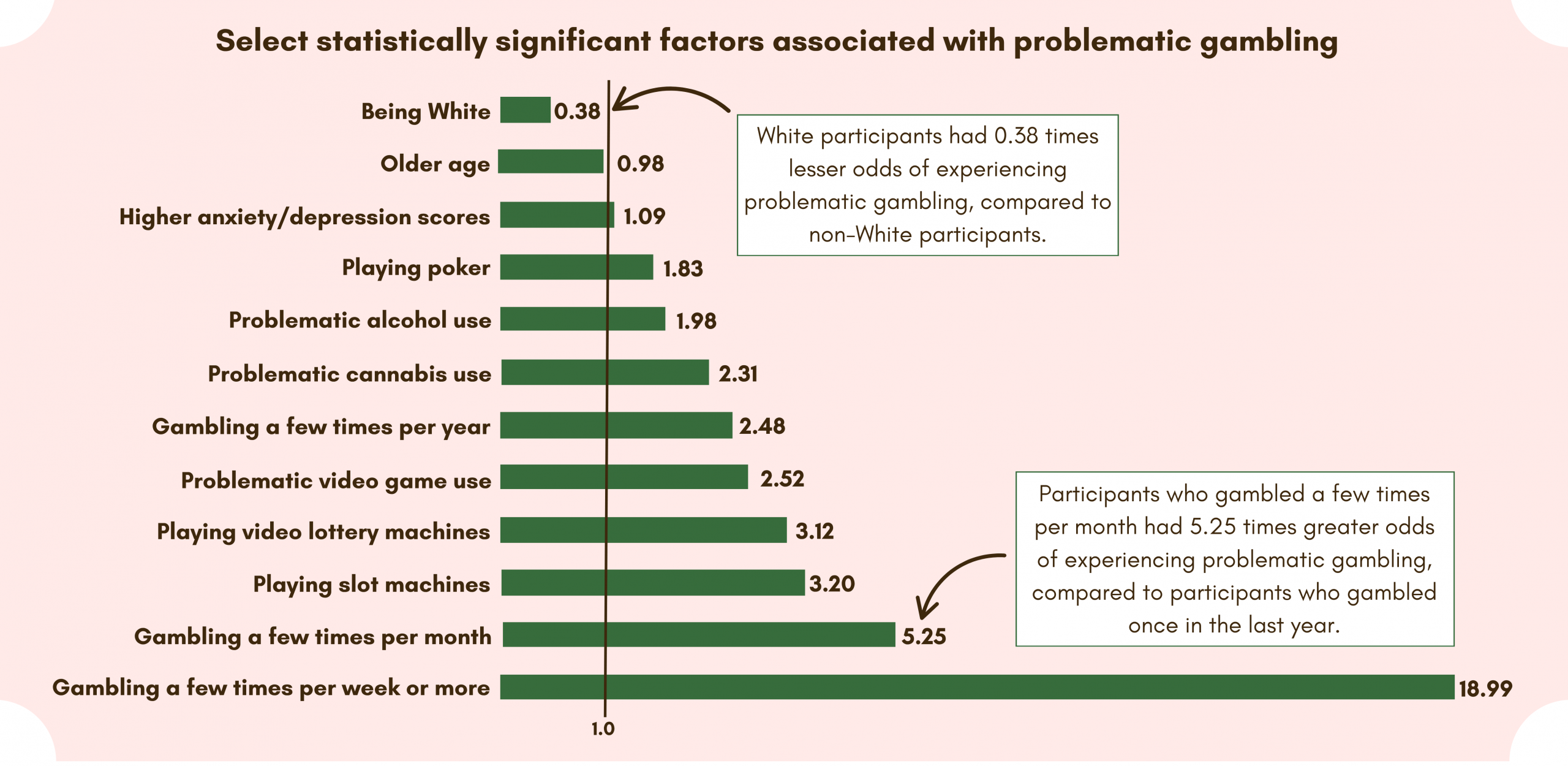
The most common forms of gambling among the entire sample were lottery tickets (75%) and scratch tickets (68%). Among those exhibiting problematic gambling, poker (53%) and video lottery machines (51%) were most prominent. Approximately one-fifth (19.6%) of participants exhibited problematic gambling. The logistic regression model identified factors associated with lower odds of experiencing problematic gambling, such as being older and White, and higher odds of experiencing problematic gambling, such as gambling more frequently, engaging in problematic substance use, engaging in certain types of gambling, and experiencing higher rates of depression/anxiety (see Figure).
Figure. Displays the odds ratios of select factors associated with problematic gambling among LGBTQ+ participants that were found to be statistically significant. Click image to enlarge.
Why do the findings matter?
The findings indicate that problematic substance use and poor mental health, along with gambling patterns, are associated with problem gambling symptoms among LGBTQ+ individuals. In doing so, they support the role of minority stress in problematic gambling. Connecting clients to community support organizations like Boston GLASS might help relieve minority stress while providing resources and offering opportunities to engage in activities that do not involve gambling. Additionally, providers should apply an intersectional lens to understand how other marginalized identities, such as non-White race, may influence a person’s vulnerability to addictive behaviors, like gambling.
Every study has limitations. What are the limitations in this study?
This study was cross-sectional, which means we cannot conclude that the identified factors caused problematic gambling. Additionally, the sample sizes for some of the subgroups was small, which might make prevalence estimates inflated or unstable, so those particular results should be interpreted with caution. Finally, qualitative studies could provide a deeper understanding of the role that identity and minority stress play in the LGBTQ+ population’s relationship with gambling.
1. More specifically, the researchers surveyed LGBTQIA2S+ individuals. This acronym stands for Lesbian, Gay, Bisexual, Transgender, Queer/Questioning, Intersex, Asexual, 2-Spirit, and other gender identities/sexual orientations not explicitly listed.
Page 3 of 35«12345...102030...»Last »