Oct 27, 2026 | ABOUT MNAPG
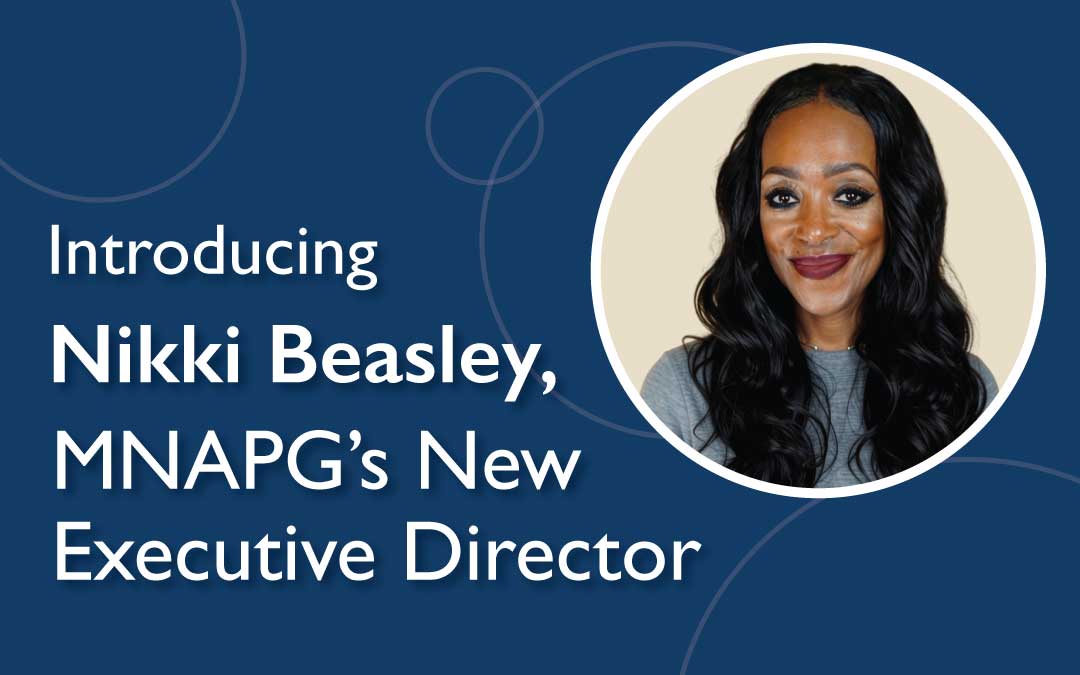
The Minnesota Alliance on Problem Gambling (MNAPG) is pleased to welcome Nikki Beasley as its new executive director. Beasley officially joined MNAPG on September 1.
Nikki brings more than 20 years of experience leading mission-driven organizations and programs. Most recently, she served as executive director of the Conflict Resolution Center. Her previous leadership roles include positions with Foster Advocates, Women’s Advocates, YWCA St. Paul, Breaking Free and The Bridge for Youth.
Throughout her career, Nikki has focused on helping people and communities facing complex challenges. She has also developed strong relationships across Minnesota’s legislative and education communities and brings direct experience working within the Minnesota Department of Human Services ecosystem. That includes managing DHS-funded programs, working with state program staff, overseeing contracts and aligning outcomes with state priorities.
That combination of experience made Nikki a particularly strong fit for MNAPG. During the search process, she demonstrated a thoughtful, collaborative leadership style and an ability to look at both the day-to-day needs of an organization and the larger systems in which it works.
Her background will be valuable as MNAPG continues building awareness of problem gambling, expanding prevention and outreach efforts, and strengthening relationships with policymakers, educators, families and community partners. Her experience working across organizations and sectors gives her a strong foundation for building the partnerships that are so important to MNAPG’s work.
Nikki also brings a strong commitment to reducing barriers to care and supporting people who are navigating difficult circumstances. She has experience building trusting relationships with staff, boards, funders, policymakers and community partners — relationships that will be important as MNAPG moves into its next chapter.
MNAPG is excited to have Nikki on board and looks forward to introducing her to the many people and organizations that make up the MNAPG community. As she gets settled into her new role, she will have the opportunity to connect with partners and learn more about the work happening across Minnesota to prevent problem gambling and connect people with support.
Please join us in welcoming Nikki Beasley to MNAPG!
Oct 19, 2026 | SPORTS BETTING
Prediction markets are drawing increasing attention across the country, raising questions about where investing ends and gambling begins. These online platforms allow people to wager money on the outcome of real-world events, ranging from elections and sporting events to economic trends and world news. Supporters often describe them as financial tools or forecasting markets, but critics argue they function much like traditional gambling.
In 2026, prediction markets have become the center of growing legal and regulatory battles. Federal regulators, particularly the Commodity Futures Trading Commission (CFTC), have argued that these markets fall under federal financial oversight rather than state gambling laws. The agency has increasingly treated prediction markets as commodities trading platforms, similar in some ways to stock or futures markets.
At the same time, many states are pushing back, saying these platforms look and operate like sports betting or online gambling. State officials have raised concerns about consumer protection, addiction risks and the lack of safeguards typically required in regulated gambling industries. Several states have attempted to restrict or ban certain forms of prediction-market activity, especially contracts tied to sports outcomes.
Minnesota lawmakers have joined that effort. Earlier this year, the Minnesota Senate voted in favor of legislation aimed at banning betting-style prediction markets within the state. Supporters of the measure argued that these platforms allow people to place wagers on uncertain outcomes in ways that closely resemble gambling, while avoiding many of the rules and taxes that apply to licensed gaming operators. However, the ban was overturned by a district court. Those closely following all these cases believe it will eventually end up at the U.S. Supreme Court.
Another major development has added to concerns about the risks tied to prediction markets. Federal authorities recently announced one of the first criminal insider-trading cases involving a prediction-market platform. Prosecutors allege that a U.S. Army Special Forces soldier used classified military information to place profitable trades tied to world events. The case highlights how these platforms can create opportunities for misuse of confidential information, similar to insider trading in traditional financial markets.
The growing popularity of prediction markets also raises broader questions about accessibility and potential harm. Because many of these platforms are available online and operate around the clock, critics worry they may normalize gambling behavior or attract younger users who may not fully understand the financial risks involved.
While supporters continue to argue that prediction markets provide useful forecasting tools, opponents see them as another rapidly expanding form of gambling disguised as investing. As courts, regulators and lawmakers continue debating how these platforms should be treated, prediction markets are likely to remain an important issue in discussions about gambling policy and consumer protection.
Oct 19, 2026 | PROBLEM GAMBLING
To learn more about Minnesota’s Alcohol and Gambling Enforcement division and how it oversees gambling activity in the state, Northern Light reached out to Jon Anglin, director of the Minnesota Department of Public Safety’s Alcohol and Gambling Enforcement (AGE) division. Below is our Q&A.
NL: Many people know your agency regulates alcohol, but fewer understand your role in gambling. Can you describe your responsibilities when it comes to gambling oversight in Minnesota?
JA: People like to jokingly call us the “fun police” because they think we take all the fun away from people. It’s a name that has stuck for 20 years. We work with organizations such as the Minnesota Lottery, the Racing Commission, which regulates card rooms and racetracks, and the Gambling Control Board (GCBP) to ensure the legality of gaming activities. For the GCB, we review lottery fraud, card cheats, horse cheats, etc. We check casinos to make sure they’re in compliance with the state’s Tribal-state compacts with games such as blackjack and video games of chance. A large aspect of our work is handling illegal gambling that may occur from online gambling, fundraising fraud and illegal activity that occurs on social media platforms, such as with sweepstakes, etc. We handle all complaints and investigate as appropriate.
NL: How has your agency’s work changed over the past five to 10 years as the gambling landscape has become increasingly digital?
JA: Our work has only gotten bigger. In addition to everything going on in every corner of Minnesota, the digital footprint is much bigger with social media. Social casinos, online gambling platforms known by different names including fantasy and sweepstakes, have moved online and expanded. This has essentially opened up the world to Minnesota, whereas it used to be that gambling just occurred at the corner bar. This means that someone’s overseas site is now in Minnesota.
NL: What challenges does your agency face in addressing offshore gambling operators that are located outside U.S. jurisdiction?
JA: We face a lot of challenges. As an example, maybe 10-15 years ago when I was a special agent in the division, the FBI called and said people were receiving large amounts of money in Minnesota from an online casino that was paying out, which doesn’t happen all the time. The company was overseas, the owners were overseas and the bank accounts were across the U.S. with one in Minnesota. The company claimed it was legal gambling because it was just sweepstakes. However, AGE determined it was illegal. Multiple states got involved and they got the bank to stop them from proceeding. We face the same problem today but the number is so much higher. We asked several agents to start counting potentially illegal online casinos, but they had to stop counting at five thousand. We only have three special agents to cover all this. The bottom line is that we don’t have the tools to really stop or disrupt all these entities. If the owner, the website and the bank accounts are in another country, what tools do we have to stop it from being in schools, where kids are, your home or anywhere in Minnesota? Ultimately, these overseas entities don’t have consumer protections, meaning we can’t protect Minnesotans from underage gambling, gambling addiction, not getting paid out, etc.
We could make it more difficult for these entities if we had authority over payment processors and could give the payment processors notice and say, “This is illegal.” They can stop the money. That would make it difficult and would be disruptive to these entities. Also, if we had the ability to reach out to advertisers and say these entities are illegal and not licensed in the state, we could tell internet service providers that it’s illegal. Tools like that could go a long way in making it more difficult and keep legal gambling in the state where we have consumer protections. When it’s illegal, for example, people who struggle with problem gambling can’t self-exclude from gaming activities.
NL: What would you like Minnesota consumers to understand before placing a bet with an offshore gambling site?
JA: These sites always say they’re legal, though they might say “void where prohibited.” If it doesn’t seem like a legal one, it’s more than likely illegal and consumers can call our agency.
NL: Do you receive complaints related to fantasy sports (realizing this not within your jurisdiction)?
JA: We receive complaints on fantasy. A lot depends on how you define fantasy. Everyone has a different definition. They moved from the original idea of matching team total numbers to over/unders, number of touchdowns to be scored, etc. — and then moved into prediction markets. The definition is always moving. It’s not always fantasy when someone says it is. The question for people playing these games to ask is whether it’s really gambling or not. Gambling is either a bet or lottery. If it’s a bet, people agree to lose something of value.
NL: How does your agency view these platforms such as sweepstakes casinos and online casinos, and what distinguishes them from legal, regulated gambling?
JA: Sweepstakes involving Coke, Mountain Dew, McDonald’s cheeseburgers, etc., are legal because they aren’t selling product to have the sweepstakes. They’re offering a sweepstakes to help sell the product. If sweepstakes don’t involve selling the product, what are you purchasing? Platforms such as online casinos say you’re purchasing entertainment to play slot machines. So how is that any different than just playing slots? All of that is illegal according to the law.
It’s important to note that AGE is not out to get the person playing these games. We want to go after the place that’s providing this illegal game. We’re here to protect Minnesotans and to make sure they get their money, that the underage population is protected and that there are protections for people experiencing gambling addiction. I’ve heard stories of people losing $75,000 and their houses.
NL: What do you think the chances are that new legislation will be passed that will give the agency the tools to put an end to sweepstakes/online casinos?
JA: It’s hard for me to speculate on that so I can’t give you a guess.
NL: How does your agency view prediction market platforms, particularly when they involve sporting events?
JA: Given ongoing lawsuits in Minnesota with regard to prediction markets, I can’t answer that. However, the statement below summarizes our position on the matter.
Minnesota law provides several lawful forms of gambling under established state regulatory frameworks. The Minnesota Department of Public Safety remains committed to carrying out its statutory responsibilities in a manner that protects public safety, consumers and the integrity of regulated gambling. The lawsuits regarding the prediction markets statute are ongoing and so we will not have further comment on the lawsuits.
NL: What trends are you seeing in complaints or consumer reports related to gambling? Have those changed in recent years?
JA: Everything has moved to online. The main complaint we hear about is people not getting their money. They’ll say, “I won $10,000 and am not getting it.” Ninety-nine percent of these complaints are from non-regulated areas. Unlike legal games in Minnesota, there is concern about the integrity of those non-regulated online games, meaning they might not be fair with payouts, there may be manipulation, cheating on slots and cards, etc.
NL: As the gambling landscape continues to evolve, what policy or enforcement challenges do you anticipate over the next few years?
JA: It’s difficult to handle the online activity without having tools. With three special agents, someone might not notice a difference if we take down one out of five thousand sites. I think our best efforts should be dedicated to addressing consumer protections and to providing more education by telling people what’s illegal and why.
NL: What do Minnesotans gain by choosing legal gambling rather than illegal or offshore options?
JA: If you enjoy gambling that’s legal in Minnesota, know that it can also benefit local communities. Lawful gambling, such as pull-tabs, helps support charities, local hockey associations, baseball fields and other community projects. That’s very different from illegal or offshore gambling, where money often leaves Minnesota.
Legal gambling also comes with consumer protections. If you gamble legally in Minnesota and aren’t paid what you’re owed, there are avenues for help. With illegal or overseas gambling, it can be much more difficult to resolve those kinds of problems.
NL: Is there anything Minnesotans should know about gambling in the state that you feel is often misunderstood?
JA: Just know that what people see online — whether it’s cards or social casinos — isn’t necessarily what it appears to be. People can always call our division to determine if something is illegal.
We want to educate Minnesotans for their own protection. Legal, regulated gambling in Minnesota provides resources to help with problem gambling and protects consumers from risks such as unfair betting. Minnesota allows the following legal gambling activities:
- Licensed charitable gambling, including pull tabs, paddlewheels, tip boards, bingo and raffles.
Minnesota Lottery.
- Pari-mutuel betting on horse races. A pari-mutuel betting system is where all the money bet is pooled together. After taking out costs, the remaining money is divided among the winners, based on how much they bet.
- Tribal gaming.
Illegal online sports betting and online casinos deservedly get a lot of attention for their risks, but there are other illegal gambling activities as well. Illegal gambling in Minnesota has the following three elements:
- Consideration: Something of value is given, directly or indirectly, to participate.
- Chance: The game must be based predominately on chance.
- Prize: The player must be able to get something of value if the player wins.
Blackjack, dice, roulette or poker are among the games that meet those criteria. Using gambling devices, such as roulette wheels or slot machines, is also illegal.
Oct 16, 2026 | HEALTHY PLAY, PROBLEM GAMBLING, PROFESSIONALS, RECOVERY, RESOURCES
For years, the front door to gambling support has looked much the same: a helpline, a counselor or a support group.
While those resources remain invaluable, they’re no longer the only way people seek help.
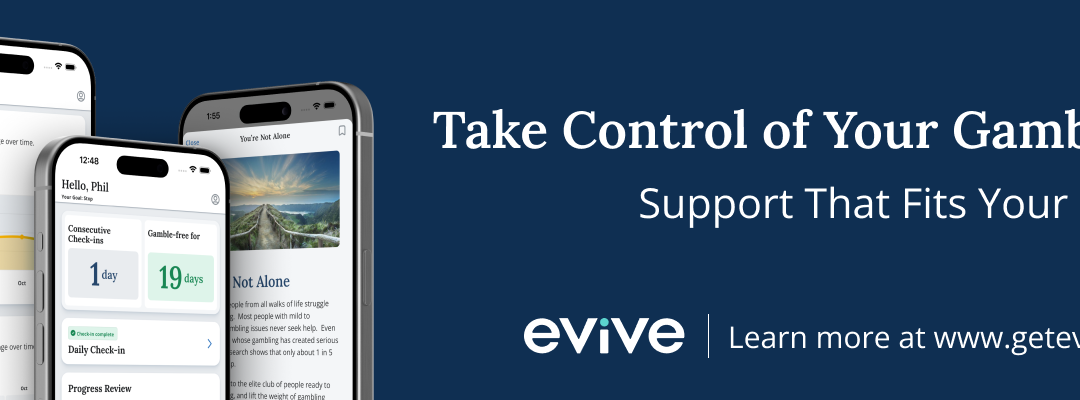
Today, many people facing challenges first reach for their phone to search for answers, connect with others or learn on their own. That’s the thinking behind Evive, a free digital platform now available to Minnesotans through the Minnesota Alliance on Problem Gambling (MNAPG).
Created by entrepreneur and person in recovery Sam DeMello, Evive combines education, self-guided tools, peer support and connections to local resources in one place. Rather than replacing traditional treatment, it’s designed to help more people find it.
“It’s not so much an app as it is digital infrastructure for the public health system,” says Sam.
What You’ll Find in Evive
• Daily check-ins
• Mood and urge tracking
• Recovery journal
• Educational lessons
• Guided coping exercises
• Peer support community
• Virtual support meetings
• Minnesota-specific resources
• Connections to counselors and treatment
• Goal options: stop gambling or manage gambling
Evive Foundation
The Evive Foundation provides help for gambling problems to anyone who needs it, regardless of income, location or insurance status. The foundation operates as a fiscal sponsorship program under a 501(c)(3) nonprofit charity, helping make support more accessible to people affected by gambling.
Built from Lived Experience
Sam didn’t set out to build a gambling recovery platform. He spent more than a decade building technology companies before entering the digital health field, where he saw how software was being used to help people manage behavioral health conditions. At the same time, he was quietly fighting a gambling addiction that had begun in childhood.
His gambling started with poker at age 12 and escalated dramatically with online sports betting. Despite earning a good living and paying his bills, he lost hundreds of thousands of dollars over the years.
“I looked very successful,” he says. “The addiction wasn’t just hidden from other people. It was hidden from me.”
Because he wasn’t bankrupt and didn’t fit the stereotype often associated with gambling disorder, he never believed treatment was meant for someone like him. When he finally sought help, he found caring professionals, but many resources simply didn’t reflect his experience.
“I was gambling on my cellphone with cryptocurrency,” he recalls. “They were talking about the horse track in 1978.”
Eventually, with support from his wife and a better understanding of the neuroscience behind addiction, he entered recovery. As his life improved, he assumed that chapter was behind him.
Then, after unexpectedly losing his job in 2023, he began searching for tools that could strengthen his recovery. He hoped to find a comprehensive digital resource, but instead found a gap. “There was nowhere that you could go to find all of the resources in one place,” he says.
Meeting People Where They Are
One of Evive’s defining characteristics is that it doesn’t require users to identify as having a gambling problem. When someone opens the platform, they’re simply asked what they’d like to accomplish: stop gambling or manage gambling.
“The reason it’s called Evive and not ‘Quit Gambling Today’ is because it’s for everybody,” says Sam.
Rather than labeling people, Evive focuses on helping them understand their own behavior and supporting whatever positive changes they’re ready to make.
“I don’t need to tell people to stop gambling,” says Sam. “I just need to hold up a mirror.”
Support Whenever It’s Needed
Evive brings together resources that are often scattered across multiple organizations, including daily check-ins, tracking tools, educational lessons, coping exercises, virtual peer meetings and direct connections to local treatment resources.
For Minnesotans, the experience is customized with links to MNAPG resources and services available throughout the state.
Community First
Although Evive includes sophisticated technology, its greatest strength isn’t the software. “The community is probably the most valuable experience,” says Sam. Members encourage one another, share setbacks and successes, attend recovery meetings together and remind each other they’re not alone. The community aspect helps address the shame and stigma that keep many from reaching out for help.
A Partner for Minnesota
MNAPG partnered with Evive because it complements — not replaces — the state’s existing prevention, treatment and recovery efforts.
For someone who’s ready to call the helpline or meet with a counselor, those resources remain available. For someone who’s not quite ready, Evive offers another path into the support system.
Sam believes that’s essential as gambling continues to evolve. “If we’re going to address this problem in the United States we have to break the stigma,” he says.
For him, every person who discovers they aren’t alone represents progress. “The reason I talk about it out loud now is that every time I do, I get emails from people saying, ‘I didn’t think anyone else was like me.’”
That’s ultimately what Evive hopes to offer Minnesotans—a welcoming first step toward support, recovery and hope, wherever they are on their journey.
Oct 16, 2026 | CONCERNED OTHERS, PROBLEM GAMBLING, RECOVERY, STORIES
As someone who’s been addicted to both gambling and substances — and who was even charged with a drug felony — I can honestly say that nothing compares with the shame of a gambling addiction. To realize you’ve maxed out your debt, opened credit cards using your husband’s name without his knowledge and then had to tell the people you love what you’ve done … there’s nothing that makes you feel more ashamed.
The good news is that I found help for my gambling addiction. I still struggle to share my full story with people I talk to, but I’m working on it.
While my gambling addiction started about five years ago, in many ways the roots go back to 1998. That’s when I was in a car accident that left me with herniated discs. The first treatment was narcotics. That was fine until 2007, when I lost twins at 22 weeks due to preterm labor. That’s when I started using the narcotics to numb the grief.
Fast-forward to about five years ago. I went with a friend to the casino. I set out $50 or so to spend. No problem. I remember my friend telling me that I shouldn’t come alone to a casino. But after I won one time, I went back alone — and won again. Before long, gambling became another addiction. I would take several hours out of the day to go to the casino, which was about a 45-minute drive away. Eventually, I started going at night and would stay there all night.
I only gambled for about a year, but it escalated quickly. At first, I just played the penny and nickel slots. At some point I had a big win and moved on to higher stakes, such as the $10 slots. I remember that my ex-husband owed me $40,000. I blew all of that in one day, went back the next day and won it all back, and then went back the next day and lost it all again. The more I could bet, the more excitement I felt when I won. It was like my brain was craving that feeling.
My gambling debt quickly accumulated to more than $100,000. My husband took out a line of credit with our bank to use for home improvements, and I gambled that away too. The casinos would advance thousands of dollars, and eventually I maxed that out, too.
“I couldn’t grasp how I could be addicted when no substance was entering my body. I learned how the wins and the anticipation of winning affected my brain, and I came to understand that addiction isn’t necessarily about a substance.”
Finally, at my husband’s urging, I surrendered and sought help. I told my parents about my gambling and started going to Gamblers Anonymous (GA). My husband went to Gam-Anon. I noticed some of the similarities with GA’s 12-step approach with what happens at the AA meetings I continued to attend. I didn’t realize how quickly I could essentially switch addictions. Now I know I can become addicted to anything.
At first, I couldn’t grasp how I could be addicted when no substance was entering my body. I learned how the wins and the anticipation of winning affected my brain, and I came to understand that addiction isn’t necessarily about a substance. For me, gambling was affecting my brain in much the same way my substance addiction had.
At about the same time my gambling took off, I was being treated for restless legs syndrome. I later learned that the medication I was prescribed can cause a compulsive urge to gamble. I assume that was also a factor in my behavior.
I’m doing well in my recovery now, but I have to be smart and careful. I’ve been to Las Vegas several times since I started my recovery and always make sure to check in with my sponsor. Sometimes the cravings are still there, and they can be really strong. I also occasionally perform a music gig at casinos, and I’m careful to make sure someone is always with me.
I occasionally go back to the place where I received treatment for my substance addiction to share my story. Unfortunately, I still don’t feel comfortable sharing the gambling piece of my journey. I’m still trying to overcome that shame.
There are two important things I’ve learned through my experience. The first is to be aware of “switching addictions.” If you’re prone to addiction, you’ll probably find another addiction, even one that doesn’t involve ingesting anything into your body.
The second message is that you should be careful not to isolate or hide. Being alone is what triggered all this for me. I now realize that addiction is taking something on the outside to fix something on the inside and, for an effective recovery, you need community.