
Oct 7, 2022 | PROBLEM GAMBLING, RESEARCH
Read the original article on The BASIS.
By Caitlyn Matykiewicz, MPH
Social casino games have become very popular during the past decade. Typically played on mobile devices, these online games are connected to social networking sites, allowing players to see their scores on leaderboards and share results with their friends. Social casino games resemble gambling activities like slot machines (aka electronic gambling machines [EGMs]), even including similar sounds and offering in-game purchases or microtransactions with rewards of virtual points. Because they are free to play and the player cannot win any real money from the outcome, social casino games are not currently considered gambling. However, people who play simulated gambling games, such as social casino gamers, might be more likely to experience gambling problems. This week, The WAGER reviews a study by Hyoun S. Kim and colleagues that investigated motives for playing social casino games and transitioning between social casino games and gambling.
What were the research questions?
Why do people who gamble play social casino games? Why do people transition from social casino games to gambling? Why do people transition from gambling to social casino games?
What did the researchers do?
The researchers recruited 269 United States residents who both gambled and played social casino games. Through an online survey, participants provided their top three reasons for playing social casino games, transitioning to gambling after playing social casino games, and transitioning to social casino gaming after gambling. Participants also completed the Problem Gambling Severity Index (PGSI). The researchers conducted a thematic analysis of participant responses and identified key motives for each of the three research questions.
What did they find?
For all three research questions, the most frequently mentioned motive was playing for enhancement–in other words, to experience fun, entertainment, excitement, or thrill (see Figure). Participants also played social casino games to alleviate boredom (46%) and for social reasons (29%). Among participants who started with social casino games and transitioned to gambling, 70% reported the opportunity to win real money as a motive for doing so. Availability (42%) and affordability (31%) were common reasons for switching from gambling to social casino games. Gambling-harm minimization was another motive for playing social casino games, among all participants (17%) and among those who transitioned from gambling (28%). Motives for playing social casino games did not differ by PGSI score category.
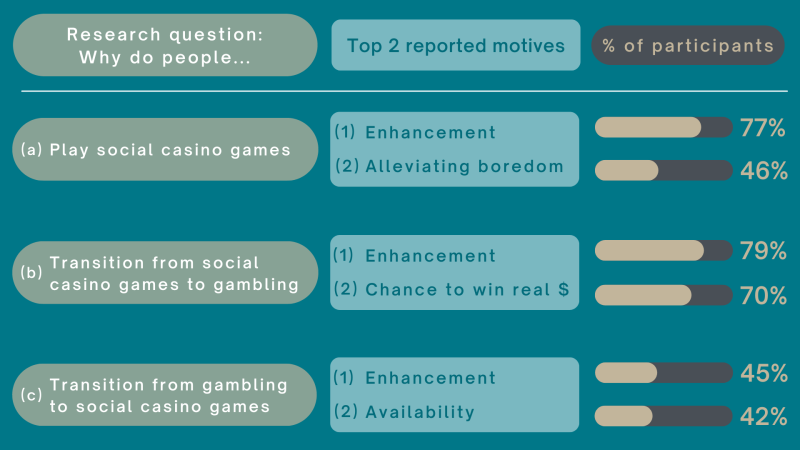 Figure. Top two reported motives for why people (a) play social casino games, (b) transition from social casino games to gambling, and (c) transition from gambling to social casino games.
Why do these findings matter?
Social casino games can be a potential precursor to gambling and gambling problems. A majority of participants reported that they began gambling as a way to win real money, which is concerning because social casino games have inflated payout rates that could give players a false perception of skill. Players should be informed that their odds of winning in social casino games do not necessarily reflect the odds of winning in gambling.
On the other hand, many participants reported playing social casino games to reduce the chance of gambling harm, as it can satisfy their urge to gamble without them risking any real money. Social casino games may be a potential harm reduction strategy to help people with gambling problems cut down on their gambling behavior, though more research is needed to determine its effectiveness and the harm that results from spending too much time on social casino gaming.
Every study has limitations. What are the limitations in this study?
Participants were limited to United States residents who both gambled and played social casino games, so the results might not be generalizable to people who live in other countries or to people who currently play social casino games but have not yet transitioned to gambling. Because this study was cross-sectional, we also cannot determine whether any of these motives actually caused changes in social casino gaming or gambling behavior.
For more information:
Do you think you or someone you know has a gambling problem? Visit the National Council on Problem Gambling for screening tools and resources. For additional resources, including gambling and self-help tools, please visit our Addiction Resources page.
Figure. Top two reported motives for why people (a) play social casino games, (b) transition from social casino games to gambling, and (c) transition from gambling to social casino games.
Why do these findings matter?
Social casino games can be a potential precursor to gambling and gambling problems. A majority of participants reported that they began gambling as a way to win real money, which is concerning because social casino games have inflated payout rates that could give players a false perception of skill. Players should be informed that their odds of winning in social casino games do not necessarily reflect the odds of winning in gambling.
On the other hand, many participants reported playing social casino games to reduce the chance of gambling harm, as it can satisfy their urge to gamble without them risking any real money. Social casino games may be a potential harm reduction strategy to help people with gambling problems cut down on their gambling behavior, though more research is needed to determine its effectiveness and the harm that results from spending too much time on social casino gaming.
Every study has limitations. What are the limitations in this study?
Participants were limited to United States residents who both gambled and played social casino games, so the results might not be generalizable to people who live in other countries or to people who currently play social casino games but have not yet transitioned to gambling. Because this study was cross-sectional, we also cannot determine whether any of these motives actually caused changes in social casino gaming or gambling behavior.
For more information:
Do you think you or someone you know has a gambling problem? Visit the National Council on Problem Gambling for screening tools and resources. For additional resources, including gambling and self-help tools, please visit our Addiction Resources page.
Aug 10, 2022 | RESEARCH
Susan Sheridan Tucker provides a breakdown of the pre-conference sessions provided by the National Council on Problem Gambling on June 8-9.
One of the unanticipated benefits of the COVID pandemic is the variety of excellent content available on virtual platforms. NCPG has pivoted to providing conference content via Zoom for the past two years. This year, while committed to meeting in person in Boston in July, two half-day virtual sessions were added for those seeking CEUs who might not be able to travel and for those seeking supplemental information to the in-person conference.
This year, 30-minute sessions were offered on an array of topics. The first day’s sessions included:
- Updates on this year’s past legislation.
- The not-to-be ignored rise in women sports betting.
- Black women sharing their recovery stories and how they carved out recovery paths that met their cultural needs.
- The ability to track markers of harm for online gamblers and what some operators are doing to communicate with players with problematic gambling.
- The promotion of International Gambling Counselor Certification Board (IGCCB)-approved gaming disorder training.
- A provider’s ruminating over lessons learned in creating a problem gambling treatment program from scratch and living to tell the tale.
- An awareness alert about gambling activites in the expanding metaverse – the creation of casinos and other gambling venues within virtual worlds in which one’s aviator is actually engaged in gambling activities.
The second day did not disappoint. The sessions included:
- The Massachusetts Council explained how it has instituted remote self-exclusion applications in conjunction with its successful Game Sense program.
- Descriptions of the emotional rollercoaster a family experiences when living with a person with problem gambling.
- Learning what a public health response to sports betting looks like in the state of Maryland.
- A summary of the wildly diverse and disjointed implementation of sports betting and regulations in 25-plus states.
- Building and implementing diversity, equity and inclusion into community outreach practices in the state of Massachusetts.
- The announcement of the new national helpline number, 1-800-GAMBLER, and the NCPG modernization project that will improve services for states without their own helplines and improve transitions to ensure anyone who calls is directed to their appropriate state helpline. (See separate article on 1-800-GAMBLER.)
The programs were stimulating, always leaving me to ponder how we can do better in Minnesota. It also left me a bit envious of some of my colleagues in other states who are provided appropriate funding for their problem gambling programs, integrating care, services, research and, above all, are able to acknowledge and respond to gambling disorder as a public health issue.

Apr 29, 2022 | PROBLEM GAMBLING, PROFESSIONALS, RESEARCH
Read the original article on The BASIS here.
By Kira Landauer, MPH
Many jurisdictions require online gambling operators to provide digital features that are intended to help players gamble more responsibly and minimize gambling-related harms. These consumer protection tools (CPTs) include setting limits on the amount of money one can deposit into their account (deposit limits), the ability to temporarily deactivate one’s account for a short period of time (timeouts), or the option to deactivate one’s account for a longer period of time (self-exclusion). But, do online gamblers actually use the CPTs available to them? This week, The WAGER reviews a study by Robert M. Heirene and colleagues that examined CPT use among customers of multiple online gambling operators in Australia in 2018 – 2019.
What were the research questions?
Which CPTs are used and how often are CPTs used by customers across six major Australian online gambling operators during a 12-month period? Does CPT use vary depending on customer demographics or wagering behavior?
What did the researchers do?
The researchers obtained de-identified account data for 39,853 customers across six online wagering operators in Australia. The records covered July 2018 to June 2019. All customers wagered at least once during this period. Customer data included demographics and (for the 12-month study period): the use of any CPTs (deposit limits, timeouts, and self-exclusion), transaction details (e.g., withdrawals and deposits), and all bets placed.
The researchers examined the overall prevalence of CPT use. They placed customers into quartiles based on their betting intensity (i.e., median number of bets per active betting day). CPT use was compared across customer betting intensity quartiles. The researchers also examined demographic characteristics and wagering behaviors among different groups of CPT users (non-uses, deposit limit setters, and timeout and/or self-exclusion users).
What did they find?
Only 16.8% of customers used at least one CPT during the 12-month study period. Deposit limits were the most frequently used CPT (15.8% of customers). Timeout and self-exclusion tools were used by less than 2% of customers (see Figure). CPT use increased linearly with gambling intensity. Rates of CPT use (timeouts and self-exclusion, in particular) were highest among customers who gambled more intensely. Customers most often used deposit limits first, or used deposit limits and a timeout in the same day. Many customers made changes to their deposit limits. Increasing the deposit limit (i.e., making it less restrictive) was the most frequent change. Customers who made the most changes to their deposit limits were more likely to increase or remove the limit.
Compared to non-CPT users and deposit limit setters, customers who used timeouts and/or self-exclusion were more likely to be younger, male, bet more times per active day, lost more money, deposited more money into their accounts, and had higher median stake amounts during the study period. Few differences were observed between the non-CPT users and the deposit limit setters.
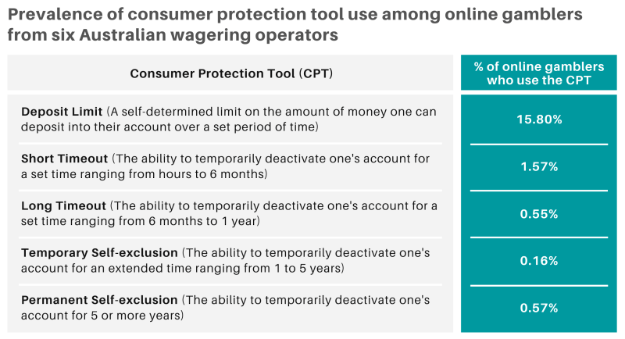 Figure. The prevalence of use of different consumer protection tools among online gamblers from six Australian wagering operators (total n = 39,853).
Why do these findings matter?
Low rates of CPT usage might be attributed to a general lack of awareness that these tools exist. Further, customers may not be engaging with these tools due to the misperception that CPTs are intended for customers with gambling problems. Operators should do a better job of promoting these tools and communicating their relevance and benefits to all customers. Gambling operators might also consider using an “opt-out” strategy for certain CPTs, like deposit limits. In this case, customers would be provided an opportunity when signing up to either set a deposit limit or actively opt-out of doing so, which might increase the use of this CPT. Finally, this study found that limits are often increased or removed by customers at risk of experiencing gambling problems, at least according to their gambling intensity. Operators might consider imposing greater restrictions on the ability to increase or remove limits, and could consider implementing strategies to help customers set and stick to appropriate limits.
Every study has limitations. What are the limitations of this study?
This study used customer data from Australian gambling operators, where online gambling is restricted to sports and race wagering. Findings might not be generalizable to other jurisdictions that offer other forms of online gambling, such as online poker or casino games.
For more information:
Do you think you or someone you know has a gambling problem? Visit the National Council on Problem Gambling for screening tools and resources. For additional resources, including gambling and self-help tools, visit our Addiction Resources page.
-- Kira Landauer, MPH
Figure. The prevalence of use of different consumer protection tools among online gamblers from six Australian wagering operators (total n = 39,853).
Why do these findings matter?
Low rates of CPT usage might be attributed to a general lack of awareness that these tools exist. Further, customers may not be engaging with these tools due to the misperception that CPTs are intended for customers with gambling problems. Operators should do a better job of promoting these tools and communicating their relevance and benefits to all customers. Gambling operators might also consider using an “opt-out” strategy for certain CPTs, like deposit limits. In this case, customers would be provided an opportunity when signing up to either set a deposit limit or actively opt-out of doing so, which might increase the use of this CPT. Finally, this study found that limits are often increased or removed by customers at risk of experiencing gambling problems, at least according to their gambling intensity. Operators might consider imposing greater restrictions on the ability to increase or remove limits, and could consider implementing strategies to help customers set and stick to appropriate limits.
Every study has limitations. What are the limitations of this study?
This study used customer data from Australian gambling operators, where online gambling is restricted to sports and race wagering. Findings might not be generalizable to other jurisdictions that offer other forms of online gambling, such as online poker or casino games.
For more information:
Do you think you or someone you know has a gambling problem? Visit the National Council on Problem Gambling for screening tools and resources. For additional resources, including gambling and self-help tools, visit our Addiction Resources page.
-- Kira Landauer, MPH

Mar 22, 2022 | PROBLEM GAMBLING, RESEARCH, SPORTS BETTING
Read the original article on The BASIS here.
By Caitlyn Fong, MPH
The Professional and Amateur Sports Protection Act (PASPA), which previously outlawed sports betting in most of the United States, was repealed in 2018 by the Supreme Court. Since then, legalized sports betting has grown rapidly, with the majority of states having active legal sports betting or pending legislation to legalize sports betting. Some studies have suggested a link between sports betting and gambling harm. For sports bettors experiencing gambling-related harms, online communities can be a source of self-help information and mutual support. This week, The WAGER reviews a study by Mark van der Maas and colleagues that analyzed how posts in an online mutual support community for problem gambling have changed with the expansion of legalized sports betting.
What was the research question?
How did the volume and content of an online mutual support community for problem gambling change after the repeal of PASPA and subsequent expansion of legalized sports betting?
What did the researchers do?
The researchers collected posts from the r/problemgambling subreddit (a message board on reddit.com) from January 1, 2016 to December 31, 2020. Using interrupted time series analysis, they compared the number of posts per week before, during, and after June 1, 2018 (the first day that states other than Nevada were able to initiate legal sports betting programs).
The researchers also analyzed 558 original posts from 75 unique, randomly-selected days and all 17,041 post titles from the study period. They used thematic analysis to examine the content of the selected posts and the post titles for common themes.
What did they find?
From January 1, 2016 to June 1, 2018, message board activity grew at an average of 0.14 posts per week (see Figure). During the weeks immediately following June 1, 2018, there was an average increase of 24.2 posts per week. Following that jump in posts, message board activity sustained an increase of 0.79 posts per week, which is more than five times the pre-June 1 activity rate.
After June 1, 2018, it also became more common for posts to mention American major league sports, such as Major League Baseball (MLB), National Basketball Association (NBA), and especially the National Football League (NFL). During 2019 and 2020, posts were more likely to encourage sobriety or express worry about abstinence from gambling as the start of the NFL season approached and as the Super Bowl date neared.
 Figure. Average increase in posts per week on the r/problemgambling subreddit from January 1, 2016 through December 31, 2020.
Why do these findings matter?
The rise in number of posts and references to American major league sports indicate an increased need for treatment and support of people experiencing gambling harm, especially during the NFL season. Online mutual support communities might also be an effective way to encourage formal treatment as an option and provide relapse prevention strategies. However, people who are concerned about their gambling should also consider seeking professional help from clinicians or using evidence-based self-help resources, as some research has identified potential risks of help seeking in online communities, such as misinformation or triggering content.
Every study has limitations. What are the limitations in this study?
Most posts did not mention a specific form of gambling, so it cannot be determined whether the increase in post activity was due to greater exposure to or experience with sports betting. Reddit users tend to be younger and predominantly male, and only about half of them are based in the United States, so the study might not be representative of the United States population. As a result, the findings may also not be generalizable to people outside of the Reddit online community.
For more information:
Do you think you or someone you know has a gambling problem? Visit the National Council on Problem Gambling for screening tools and resources.
-- Caitlyn Fong, MPH
Figure. Average increase in posts per week on the r/problemgambling subreddit from January 1, 2016 through December 31, 2020.
Why do these findings matter?
The rise in number of posts and references to American major league sports indicate an increased need for treatment and support of people experiencing gambling harm, especially during the NFL season. Online mutual support communities might also be an effective way to encourage formal treatment as an option and provide relapse prevention strategies. However, people who are concerned about their gambling should also consider seeking professional help from clinicians or using evidence-based self-help resources, as some research has identified potential risks of help seeking in online communities, such as misinformation or triggering content.
Every study has limitations. What are the limitations in this study?
Most posts did not mention a specific form of gambling, so it cannot be determined whether the increase in post activity was due to greater exposure to or experience with sports betting. Reddit users tend to be younger and predominantly male, and only about half of them are based in the United States, so the study might not be representative of the United States population. As a result, the findings may also not be generalizable to people outside of the Reddit online community.
For more information:
Do you think you or someone you know has a gambling problem? Visit the National Council on Problem Gambling for screening tools and resources.
-- Caitlyn Fong, MPH

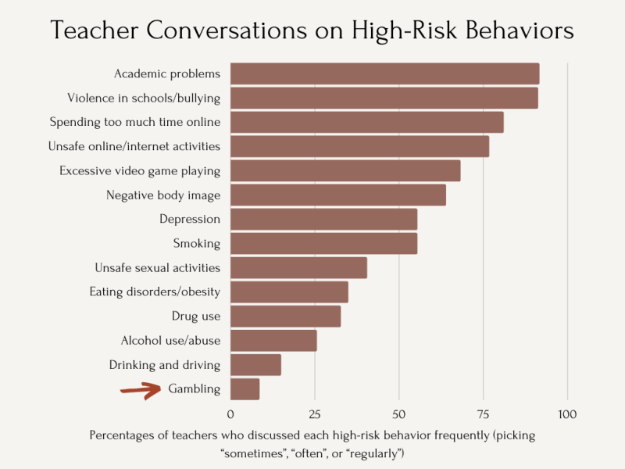 Figure. Percentages of teachers who discussed each high-risk behavior frequently (picking “sometimes”, “often”, or “regularly”). Total n = 157 primary and secondary school teachers from mainstream schools in the UK. Adapted from Figure 3 in Roberts et al. (2022).
Why do these findings matter?
It is important to provide teachers with clear information about the dangers of underage gambling and tools to address problems if they arise. This study suggests that UK teachers likely need more awareness about gambling-related harms to help prevent students from engaging in underage gambling or harmful gambling behaviors. If teachers are adequately trained, they may be more comfortable starting conversations about the dangers of gambling and providing resources to at-risk students. Additionally, they will know how to appropriately approach a student with a gambling problem and provide support while pointing them to healthcare providers or treatment sources.
Every study has limitations. What are the limitations of this study?
This study has a small sample size, so results might not be generalizable to all teachers in the UK or in other countries. Also, this study did not provide participants with a clear definition of gambling behavior, which might have led to ambiguity over what behaviors should be counted as gambling. The wording of phrases such as “excessive video game playing” compared to “gambling” may have contributed to gambling appearing as a less severe issue.
For more information:
Do you think you or someone you know has a gambling problem? Visit the National Council on Problem Gambling for screening tools and resources. Individuals in the UK can visit GamCare for problem gambling information and helpful resources. For additional resources, including gambling and self-help tools, please visit The BASIS Addiction Resources page.
Figure. Percentages of teachers who discussed each high-risk behavior frequently (picking “sometimes”, “often”, or “regularly”). Total n = 157 primary and secondary school teachers from mainstream schools in the UK. Adapted from Figure 3 in Roberts et al. (2022).
Why do these findings matter?
It is important to provide teachers with clear information about the dangers of underage gambling and tools to address problems if they arise. This study suggests that UK teachers likely need more awareness about gambling-related harms to help prevent students from engaging in underage gambling or harmful gambling behaviors. If teachers are adequately trained, they may be more comfortable starting conversations about the dangers of gambling and providing resources to at-risk students. Additionally, they will know how to appropriately approach a student with a gambling problem and provide support while pointing them to healthcare providers or treatment sources.
Every study has limitations. What are the limitations of this study?
This study has a small sample size, so results might not be generalizable to all teachers in the UK or in other countries. Also, this study did not provide participants with a clear definition of gambling behavior, which might have led to ambiguity over what behaviors should be counted as gambling. The wording of phrases such as “excessive video game playing” compared to “gambling” may have contributed to gambling appearing as a less severe issue.
For more information:
Do you think you or someone you know has a gambling problem? Visit the National Council on Problem Gambling for screening tools and resources. Individuals in the UK can visit GamCare for problem gambling information and helpful resources. For additional resources, including gambling and self-help tools, please visit The BASIS Addiction Resources page.

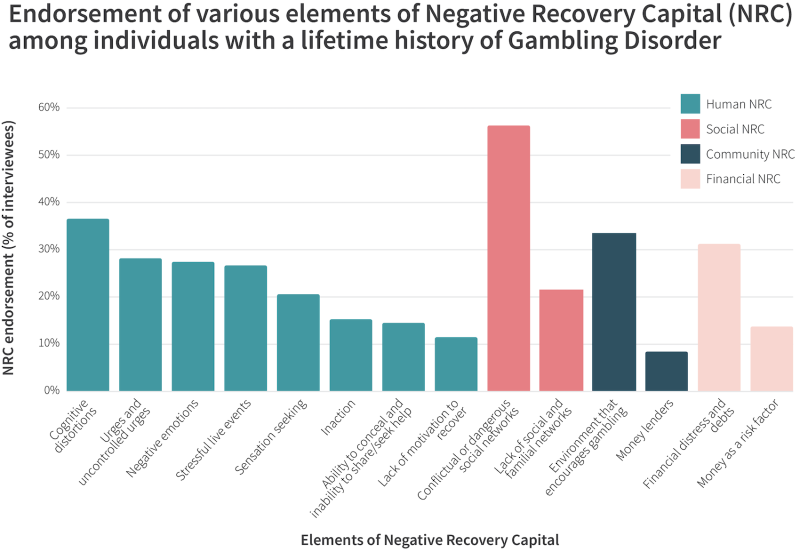 Figure. Frequencies for negative recovery capital elements that impede recovery from Gambling Disorder across the four domains of negative recovery capital (n = 133). Adapted from Gavriel-Fried & Lev-el (2022).
Why do these findings matter?
These findings illustrate the many challenges and obstacles that might impede or hinder an individual’s recovery from Gambling Disorder, and this study is the first effort to map these elements across various domains pertinent to the recovery process. This study found that many elements that challenge the recovery process fall within the Human Capital domain, suggesting a focus be placed on addressing factors within this domain during recovery (e.g., addressing cognitive distortions through cognitive behavioral therapy or motivational interviewing). Findings from this study reinforce the importance of social networks in the recovery process, and highlight that unsupportive or conflictual relationships can hinder the recovery process. Clinicians should consider including family members into the treatment process and help clients manage relationships within their social networks. While it may be beneficial to prioritize these more common NRC elements, these results suggest that a holistic approach be taken to treatment and recovery. A tailored approach should address the full range of obstacles or challenges that might impede recovery across social, financial, personal, and community domains.
Every study has limitations. What are the limitations of this study?
This study used data from individuals without an active substance use disorder who sought help for their gambling. Findings might not be generalizable to individuals with an active substance use disorder, individuals who have not sought treatment for their Gambling Disorder, or to those residing in other countries.
For more information:
Do you think you or someone you know has a gambling problem? Visit the
Figure. Frequencies for negative recovery capital elements that impede recovery from Gambling Disorder across the four domains of negative recovery capital (n = 133). Adapted from Gavriel-Fried & Lev-el (2022).
Why do these findings matter?
These findings illustrate the many challenges and obstacles that might impede or hinder an individual’s recovery from Gambling Disorder, and this study is the first effort to map these elements across various domains pertinent to the recovery process. This study found that many elements that challenge the recovery process fall within the Human Capital domain, suggesting a focus be placed on addressing factors within this domain during recovery (e.g., addressing cognitive distortions through cognitive behavioral therapy or motivational interviewing). Findings from this study reinforce the importance of social networks in the recovery process, and highlight that unsupportive or conflictual relationships can hinder the recovery process. Clinicians should consider including family members into the treatment process and help clients manage relationships within their social networks. While it may be beneficial to prioritize these more common NRC elements, these results suggest that a holistic approach be taken to treatment and recovery. A tailored approach should address the full range of obstacles or challenges that might impede recovery across social, financial, personal, and community domains.
Every study has limitations. What are the limitations of this study?
This study used data from individuals without an active substance use disorder who sought help for their gambling. Findings might not be generalizable to individuals with an active substance use disorder, individuals who have not sought treatment for their Gambling Disorder, or to those residing in other countries.
For more information:
Do you think you or someone you know has a gambling problem? Visit the