Aug 14, 2023 | ABOUT MNAPG, PROBLEM GAMBLING, PROFESSIONALS, RECOVERY
The gambling landscape continues to shift with rapid expansion and responses to regulations that seem insufficient. Those working in prevention, treatment and research need to understand and be responsive to these changes.
The MNAPG conference will feature presenters from across the country and Canada sharing their perspectives as clinicians, financial advisors, people in recovery and researchers. It will be a great way to network with others committed to minimizing the harms caused by gambling disorder and to learn more about recent trends and new tools available for those who need help.
Who Should Attend?
The conference is appropriate for many people, including:
o Gambling, alcohol and drug addiction counselors and therapists
o Other health care and social service workers
o Law enforcement officers
o School and church leaders
o Lawyers and financial professionals
o People in recovery and their families
CEU credits are available from various Minnesota professional licensing boards.
Programs and Speakers
While conference details are still falling into place as of this writing, here are some of the programs and speakers that will be part of the conference:
o Resources and Tools for Financial Counseling in Gambling Disorder Treatment, presented by Cara Macksoud, CEO of Money Habitudes, and Alex De Marco, founder and CEO of MoneyStack, Inc. and GamFin.
o The All-In Podcast Comes to Minnesota!, presented by Brian Hatch, peer recovery specialist for Bettor Choice, and Jeff Wasserman, MPA, JD, ICGC-I, CPRS, judicial outreach and development director for the Delaware Council on Gambling Problems.
o Using Affordability Guidelines as a Tool for Player Protection Online in a North American Context, presented by Lia Nower, J.D., Ph.D., a distinguished professor and director of the Center for Gambling Studies at Rutgers University.
o Working with Clients and Gambling Harms: Why it Matters and How to Lower Resistance to Treatment, presented by Jay Robinson, JR Consulting, an internationally sought-after expert in the field of preventing and responding to gambling harms.
o The Public Health Impact of Sports Betting Expansion, presented by Dr. Timothy W. Fong, M.D., a Professor of Psychiatry at the Jane and Terry Semel Institute for Neuroscience and Human Behavior at UCLA.
What:
MNAPG annual conference
When:
Sept. 18
Where:
Hilton Minneapolis/Bloomington, 3900 American Blvd W., Bloomington, MN
Cost:
$30 (free to those in recovery)
Registration deadline: September 8
For More
Information:
mnapg.org/conference
Register and and learn more HERE.
Aug 14, 2023 | RESEARCH
For the past three years, since the start of the pandemic, NCPG has offered virtual workshops prior to its regularly scheduled annual conference. This year NCPG presented a range of speakers and topics over the course of two afternoons. One advantage of online workshops is the ability to host international speakers, who might not ordinarily be able to travel. It’s also helpful for those who cannot travel to the NCPG annual conference, providing access to excellent resources from the comfort of their computers.
Several of the presenters were from the United Kingdom, where they have been dealing with the backlash from the 2005 policies that blew the door open on gambling accessibility and are now feverishly working to increase treatment services, prevention and research. Attendees benefited from listening to the lessons learned and hopefully can apply those lessons in their own backyards.
Several researchers presented on their most recent studies looking at the effectiveness of self-exclusion programs, the links between gambling and problem debt, the ever-evolving changes in gambling and responsible gambling language, and the value of providing peer support groups for women. We heard from clinicians and their experiences treating gambling as a co-occurring disorder and about a fairly new integrative treatment model called Congruence Couple Therapy (CCT), which has been shown to have a relative advantage over individual treatment for reducing addictive and mental health symptoms and improving emotional regulation among couples. There was also a panel discussion advocating for gambling policies to move into the national spotlight. With no federal funding, and the increased opportunities to gamble, the field of gambling disorder is behind in workforce development, research and programs regulating gambling harm.
See the full Summer 2023 Northern Light Newsletter (PDF).
Aug 7, 2023 | ABOUT MNAPG
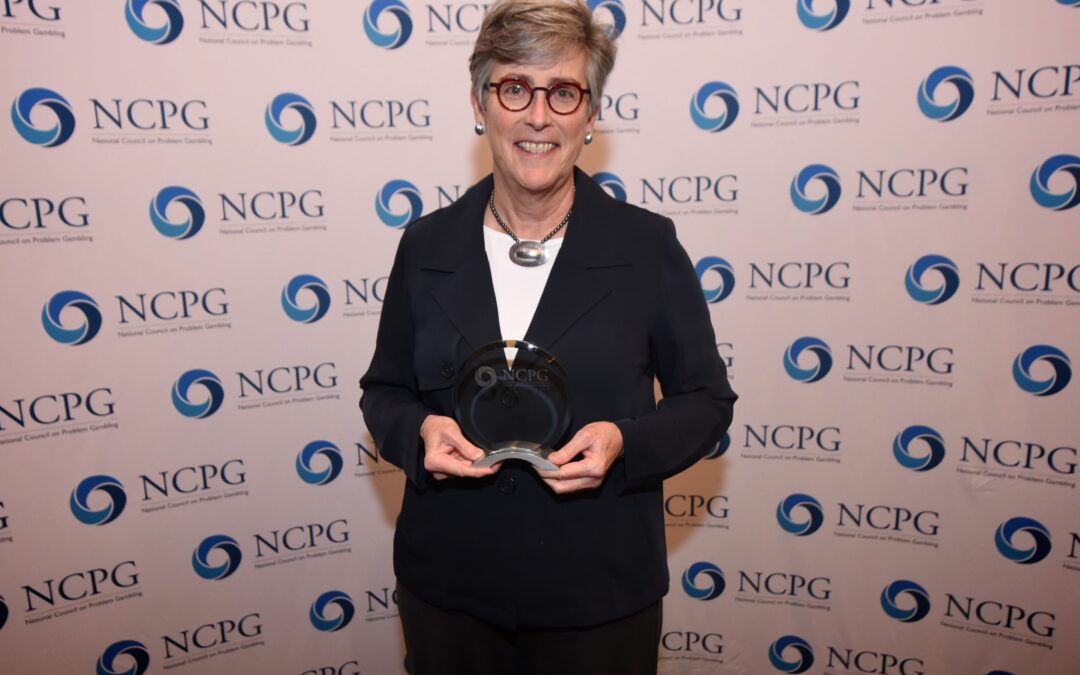
The Minnesota Alliance on Problem Gambling (MNAPG) received two national awards at the recent conference of the National Council on Problem Gambling. MNAPG received awards for the best affiliate newsletter and the best affiliate website.
“We have devoted considerable time and resources into both of these important communication tools, so we’re thrilled to see our work recognized at a national level,” says Susan Sheridan Tucker, MNAPG executive director. “I am grateful to my team for their contributions in making these useful resources.”
The 2023 Affiliate Website Award from the National Council on Problem Gambling recognizes an outstanding website that has increased awareness of problem gambling.
MNAPG’s new website is the culmination of in-depth planning into MNAPG’s various audiences. MNAPG strives to be the central hub for all things Minnesota problem gambling-related, offering access to treatment information, research findings, recovery stories and podcasts.
The 2023 Affiliate Newsletter Award from the National Council on Problem Gambling recognizes an outstanding problem gambling-related newsletter.
Northern Light, MNAPG’s quarterly newsletter, has earned several national awards since it was created in 2010. The newsletter seeks to educate visitors and readers about the latest trends in problem gambling, treatment and prevention, as well as provide updates on the organization’s outreach efforts and highlight stories of hope in recovery.
Jun 27, 2023 | RESEARCH, SPORTS BETTING
Read the original article on The Basis HERE.
By John Slabczynski.
Video games have drawn the attention of activists and public health advocates since as early as the 1970’s. Many of these activists have focused on the intense depictions of violence in video games and suggest that these depictions may lead to real-life violence. One area that is often neglected, however, are depictions of substance use and gambling in video games. Although regulators have begun to investigate loot boxes and their relationship with problem gambling, other forms of gambling in video games have received less attention. For example, skin betting (i.e., exchanging virtual goods for digital gambling currency) — which was first popularized by the game Counter-Strike: Global Offensive — has evolved from betting on in-game matches to skins being used as currency in other games of chance such as roulette. Many of those involved in these underground gambling networks are adolescents who are unable to engage in traditional gambling. This week, the WAGER reviews a study by Nancy Greer and colleagues that examined links between esports, skin betting, and problem gambling.
What was the research question?
How does esports and skin betting relate to other forms of gambling and gambling harms?
What did the researchers do?
The researchers recruited participants through Amazon Mechanical Turk and social media posts in online gaming communities to participate in an online survey. All participants reported either esports cash or skin betting, or gambling skins on games of chance in the past 6 months. In total, 737 participants completed the survey. The survey itself focused on four broad categories: (1) video game involvement, (2) video game-related gambling (including betting on esports), (3) traditional gambling, and (4) problem gambling and gambling-related harms. The researchers used ordinal logistic regression to test the hypothesis that video game involvement increases the likelihood of engaging in video game-related gambling, which in turn increases the likelihood of engaging in traditional gambling and experiencing gambling harms.
What did they find?
Though video game involvement related to video game-related gambling, video game-related gambling was only slightly related to traditional gambling. Consider three different video game-related types of gambling: esports cash betting, esports skin betting, and skin betting on other games of chance. Of these, only esports cash betting frequency significantly predicted involvement in traditional gambling activities. Interestingly, although the sample overall reported high rates of problem gambling and gambling harms, neither esports cash betting nor esports skin betting significantly predicted problem gambling or gambling harms. When controlling for other forms of traditional gambling, only skin gambling on games of chance was predictive of problem gambling and gambling harms (see Figure).

Figure. This figure displays the odds of experiencing problem gambling and gambling harms based on video game-related gambling behaviors. Odds ratios above 1.00 indicate that for every one unit increase in the predictor variable (video game-related gambling behaviors) the odds of being one category higher in the outcome variable (problem gambling or gambling harms) increases by X times. An odds ratio below 1.00 indicates that the odds decrease by X times. For example, a one unit increase in esports cash betting frequency would mean a participant is 1.033 times as likely to experience a one unit increase in their problem gambling severity. Only skin betting on games of chance was significantly associated with either outcome variable.
Why do these findings matter?
These findings suggest that buying skins and esports gambling are not risk factors for problem gambling in and of themselves. Rather, skin gambling on games of chance appears to increase the risk of gambling harms. It remains unclear whether individuals who gamble skins on games of chance do so because they have exhausted other financial resources, or if skin gambling on games of chance directly increases the risk of problem gambling and other gambling harms. Regardless, these findings suggest that regulatory bodies should consider focusing on gambling operators who facilitate skin gambling on games of chance, rather than other more traditional esports focused operators.
Every study has limitations. What are the limitations in this study?
This study has significant limitations in terms of its generalizability. Participants were required to have gambled either on esports or via using skins in the past six months, so the results likely do not represent video game players as a whole. The study also failed to include anyone under the age of 18 despite the fact that many people who gamble using skins are adolescents. Additionally, due to the study’s limited sample size, the researchers were unable to conduct path analysis, an analytical technique that allows for estimating causal effects instead of only statistical associations.
For more information:
Individuals who are concerned about their gambling behaviors or simply want to know more about problem gambling may benefit from visiting the National Council on Problem Gambling. Others who want to learn more about video game addiction can find information via the Cleveland Clinic. Additional resources can be found at the BASIS Addiction Resources page.
May 16, 2023 | RESEARCH
Read the original article on The Basis HERE.
By Kira Landauer, MPH
Editor’s Note: Today’s review is part of our month-long Special Series on Asian American/Pacific Islander (AAPI) Addiction Research. Throughout May, The BASIS is examining forms of addiction among AAPI communities.
Emerging research indicates that the Asian American community is at greater risk for problem gambling than the general population. However, research often fails to include or accurately capture the realities of gambling and problem gambling within this community, particularly the experiences of Asian American working-class immigrant communities. This week, as part of our Special Series on Asian American/Pacific Islander Addiction Research, The WAGER reviews a study by Mia Han Colby and colleagues that investigated the systemic issues that contribute to gambling in the Greater Boston Asian American community.
What was the research question?
What are the systemic issues that contribute to gambling in the Asian American community of the Greater Boston area?
What did the researchers do?
The authors conducted forty semi-structured interviews with adult members of Asian1 immigrant communities in the Greater Boston area who had a family member, friend, neighbor, or coworker who gambled. Using a community-based participatory research approach, bilingual/bicultural community fieldworkers who had experience working in their respective communities interviewed participants. Participants were asked about their perceptions of gambling in their community, as well as impacts of gambling on families and the community more generally. The researchers analyzed the interviews for common themes pertaining to systemic issues related to gambling and problem gambling in the Asian community in the Greater Boston area.
What did they find?
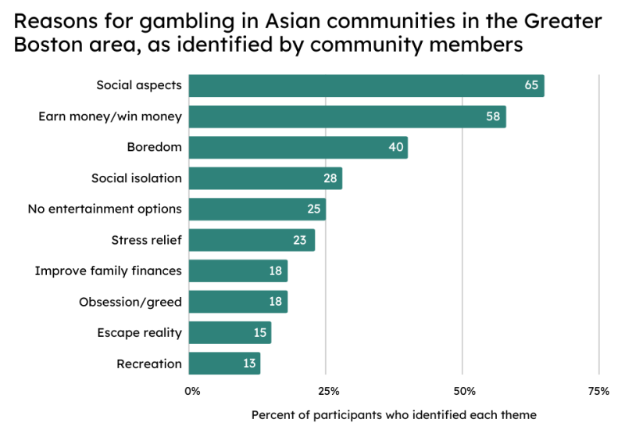
The interviews revealed how the underlying issues of poverty and social and cultural loss due to immigration contribute to gambling in this community (see Figure). Many participants spoke about the challenges of making a decent living as an immigrant while working low-wage and stressful jobs. Gambling was viewed as a way to make money and improve a family’s financial situation. For example, one participant expressed that gambling gave them “hope that they can have freedom of money.” It was also seen as a way to relieve work-related stress.
Participants also spoke about the challenges of integrating into American society due to cultural and linguistic barriers. Many discussed the lack of appropriate and accessible social and recreational activities, which contributed to experiences of social isolation, loneliness, and boredom. Gambling—especially within casinos—was viewed as a means of socializing and connecting with other Asian community members. Many participants spoke about the ways that casinos targeted Asian clientele, including busing directly to casinos from Asian communities (e.g., from Boston’s Chinatown neighborhood), creating an Asian-friendly casino environment (e.g., employees speak Asian languages, concerts and events featuring Asian artists), and incentives (e.g., free food and discounts).
Figure. Reasons for gambling in Asian communities in the Greater Boston area, by percentage of respondents who identified each reason for gambling (n = 40).
Why do these findings matter?
These findings illustrate the complex and systemic issues that contribute to gambling in Asian communities in the United States, including social and cultural isolation due to challenges integrating into American society, and struggles working low-wage and stressful jobs. Asian CARES (Center for Addressing Research, Education, and Services) of Boston created actionable recommendations for change based on these findings. They recommend investing in neighborhoods where Asian immigrants live and work to create inclusive spaces that facilitate social and recreational activities other than gambling. Additionally, Asian CARES recommended increasing funding to trusted community-based organizations (e.g., Boston Chinatown Neighborhood Center) that provide culturally and linguistically responsive problem gambling, mental health, and social services (e.g., services that help individuals find and maintain employment).
Every study has limitations. What are the limitations of this study?
Data were self-reported and based on past experiences, so the results might be subject to recall bias. Findings from this study might not be generalizable to other geographic areas or to other immigrant populations.
For more information:
Do you think you or someone you know has a gambling problem? Visit the National Council on Problem Gambling for screening tools and resources. For individuals in Massachusetts looking for culturally and linguistically relevant problem gambling services, call the Massachusetts Problem Gambling Helpline (800-327-5050) or visit the Boston Chinatown Neighborhood Center website.
1. Interviews were conducted with members of the Khmer, Chinese, Korean, and Vietnamese immigrant communities in the Greater Boston area.
Page 20 of 35« First«...10...1819202122...30...»Last »