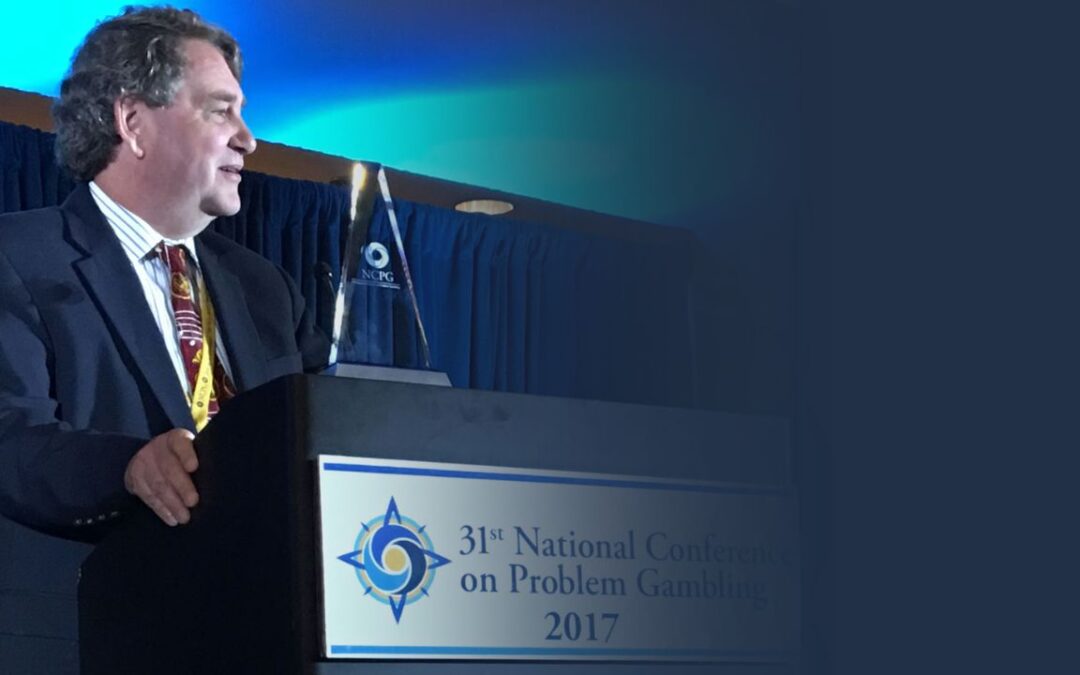
As the Minnesota Alliance on Problem Gambling marks its 25th anniversary, few people have a longer view of its history than Don Feeney, who has been involved since the very beginning and serves on the MNAPG board. In this conversation, he reflects on the organization’s origins, its evolution and what lies ahead.
NL: What do you remember most about the early days of MNAPG?
DF: One thing that’s important to say up front is that the credit for founding the organization really belongs to George Andersen, who was the first director of the Minnesota Lottery director. George called me into his office one day and said, “We need an organization in this state that can serve as a reliable source of information about problem gambling.” At that point, gambling itself was still very controversial, and there were a lot of loud voices, especially among legislators and in the media. What was missing was a factual, credible voice.
Minnesota didn’t have an affiliate of the National Council on Problem Gambling at the time, and George told me to, “Go make that happen.” The first thing I did was reach out to Roger Svendsen and Lance Holthusen. We met for breakfast at Keys in Roseville and agreed to form a state council. Roger brought a lot of credibility. He was well known nationally and was already involved with the gambling helpline through the Minnesota Department of Health. Lance was a passionate advocate. We pulled together a board, and by September 2001, we had our first meeting.
From the beginning, it was a very diverse group, which is why we chose the word “alliance.”
NL: What were some of the biggest challenges in those early years?
DF: Funding was our biggest challenge. Lance became the first executive director, and I was elected treasurer early on. There were times when we genuinely didn’t know if we’d be able to pay him in a given month. Sometimes we could, sometimes we couldn’t. It was a constant struggle to find a reliable source of funding. That went on for several years until we were finally able to get legislation passed that provided state funding.
NL: That funding effort brought together some unlikely partners. What do you remember about that?
DF: It was actually pretty remarkable. You had lobbyists representing the racetrack, the tribes, charitable gambling — all going together from office to office at the legislature and saying, “You should vote for this.” Legislators were surprised to see that kind of coalition. I think that moment helped people realize this wasn’t about advancing one segment of the industry. It was about addressing a real issue.
NL: What accomplishments or milestones stand out to you over the years?
DF: There wasn’t just one big moment — there were a lot of “baby steps.” Having said that, the first time we held a conference was a milestone. The first time we could say we were actually able to pay an executive director — that was huge. And of course securing that first state funding bill was a major turning point.
But some of the most meaningful progress came more gradually. You started to see MNAPG being quoted in the media. Reporters would call for information or perspective. Our board chair or executive director would get calls asking for facts or context. That’s when it felt like we had really become what we set out to be — a trusted, credible source.
NL: There was some skepticism early on about the organization. How did you navigate that?
DF: There definitely was. People would look at the board and see representatives from Indian gaming, Canterbury Park, the lottery, charitable gambling — and wonder if this was just a front to whitewash the issue. But they also saw people from treatment centers, the helpline and people in recovery. Over time, it became harder to dismiss the organization. We made a conscious decision to stay calm, stay factual and let the work speak for itself. Eventually, that approach paid off.
NL: Over the past 25 years, how has the conversation around problem gambling changed?
DF: It depends on who you’re talking about. There’s still a tendency among many people to view problem gambling as a moral weakness. Surveys at both the state and national level suggest that hasn’t changed as much as you might hope. And that’s unfortunate — because if you see it that way, you’re less likely to recognize the value of treatment.
At the same time, there has been some progress. There’s broader recognition now that gambling is something many, if not most, people do at least occasionally, and that most people do so without negative consequences.
There’s less hysteria around the issue than there used to be. But there’s still a tendency for people to think, “That happens to someone else, not to me or people like me.” And there’s still a lot of misunderstanding about what problem gambling really is and how it develops.
NL: What things have remained constant over time with MNAPG?
DF: A core message from the beginning is that: there is help, it’s free and it works. We’ve worked hard to make sure that’s not just a slogan — that it’s something the state can actually deliver. That hasn’t always been easy, but it’s been a constant focus.
NL: Looking ahead, what challenges do you see for MNAPG and the field in the next 10 to 20 years?
DF: The biggest challenge is that people keep finding new ways to gamble. A lot of what we’re seeing now exists in a gray area, things like prediction markets or other forms of online activity that may not technically be legal in Minnesota, but are still very accessible. In many cases, enforcement at the state level is extremely difficult. Online gambling, in particular, has a tremendous reach. Even where it’s not legal, that’s often more of a technicality than a real barrier. So the landscape keeps evolving, and we’ll have to keep adapting along with it.
NL: When you look at MNAPG today, what stands out to you most?
DF: Honestly, it’s how far we’ve come. Twenty-five years ago, the idea that we would have stable funding and multiple staff members would have seemed out of reach. At that time, we were like many other state councils, just trying to survive on a shoestring. Not every state council has been able to make the transition to a staffed, funded and professional organization. Today, we’re recognized across the nation as a leader, and that’s something I find pretty remarkable.
NL: As you reflect on these 25 years, what are you most interested to see in the future?
DF: I’m very interested to see what the next 25 years bring — both in terms of how gambling evolves and how organizations like MNAPG continue to respond. If the past is any indication, the gambling environment will keep changing. And we’ll have to keep finding ways to meet that challenge and accomplish our mission.
Frequently Asked Questions
When was the Minnesota Alliance on Problem Gambling founded?
MNAPG was founded and held its first meeting in September 2001.
Who were the founders of MNAPG?
George Andersen, the first director of the Minnesota Lottery, is credited with initiating the founding. He asked Don Feeney to make it happen, who then collaborated with Roger Svendsen and Lance Holthusen to form the state council.
What are the biggest challenges facing problem gambling organizations today?
According to Don Feeney, the biggest challenge is the constantly evolving landscape of gambling, particularly the tremendous reach of online gambling and prediction markets that operate in gray areas of legality.