

Read the original article on The BASIS.
By Justin Huynh, MPH
People with a gambling disorder (GD) often experience a poorer quality of life. As a result, substantial research has explored the topic of suicidal ideation and suicide death in association with GD. However, the impact GD has on overall death risk has been less examined, especially among siblings who share genetics and early-life environmental factors that may greatly affect later life outcomes including suicide risk. This week, The WAGER reviews a study by Yang-Chieh Brian Chen and colleagues that examined how gambling disorder may be associated with suicide risk in Taiwan using both matched controls and siblings as comparators.
What were the research questions?
(1) Relative to their siblings and matched controls, to what extent do people with GD have higher risk for death by suicide, accidents, and other causes in Taiwan? (2) Are people with GD at greater risk for unnatural death, including death by suicide, even after accounting for co-occurring mental health conditions?
What did the researchers do?
The researchers used 2000 to 2022 data from Taiwan’s National Health Insurance Database to identify three groups for retrospective comparison. These groups included 961 individuals diagnosed by a psychiatrist with GD, 3844 age- and sex-matched controls, and 675 siblings of people with GD who were not diagnosed with GD themselves. The researchers used Cox regression models to estimate risk for deaths from any cause, natural causes, and unnatural causes (i.e. accidents and suicides) in each group.¹ Further, the researchers explored whether effects remained after adjusting for co-occurring mental health conditions.
What did they find?
Over a mean follow-up period of about eight years, the GD group, controls, and siblings had death rates of about 6.8%, 4.4%, and 3.7%, respectively. The GD group had a 5.50-fold increased risk for unnatural death, and an 8.84-fold increased risk for suicide, compared to the control group. Additionally, they had a 0.66-fold decreased risk of natural death (see Figure). Importantly, the increased risk of unnatural death and death by suicide remained after the researchers adjusted for mental health conditions. In comparison to their siblings who were unaffected by gambling, the GD group had an 8.65-fold increased risk for unnatural death.
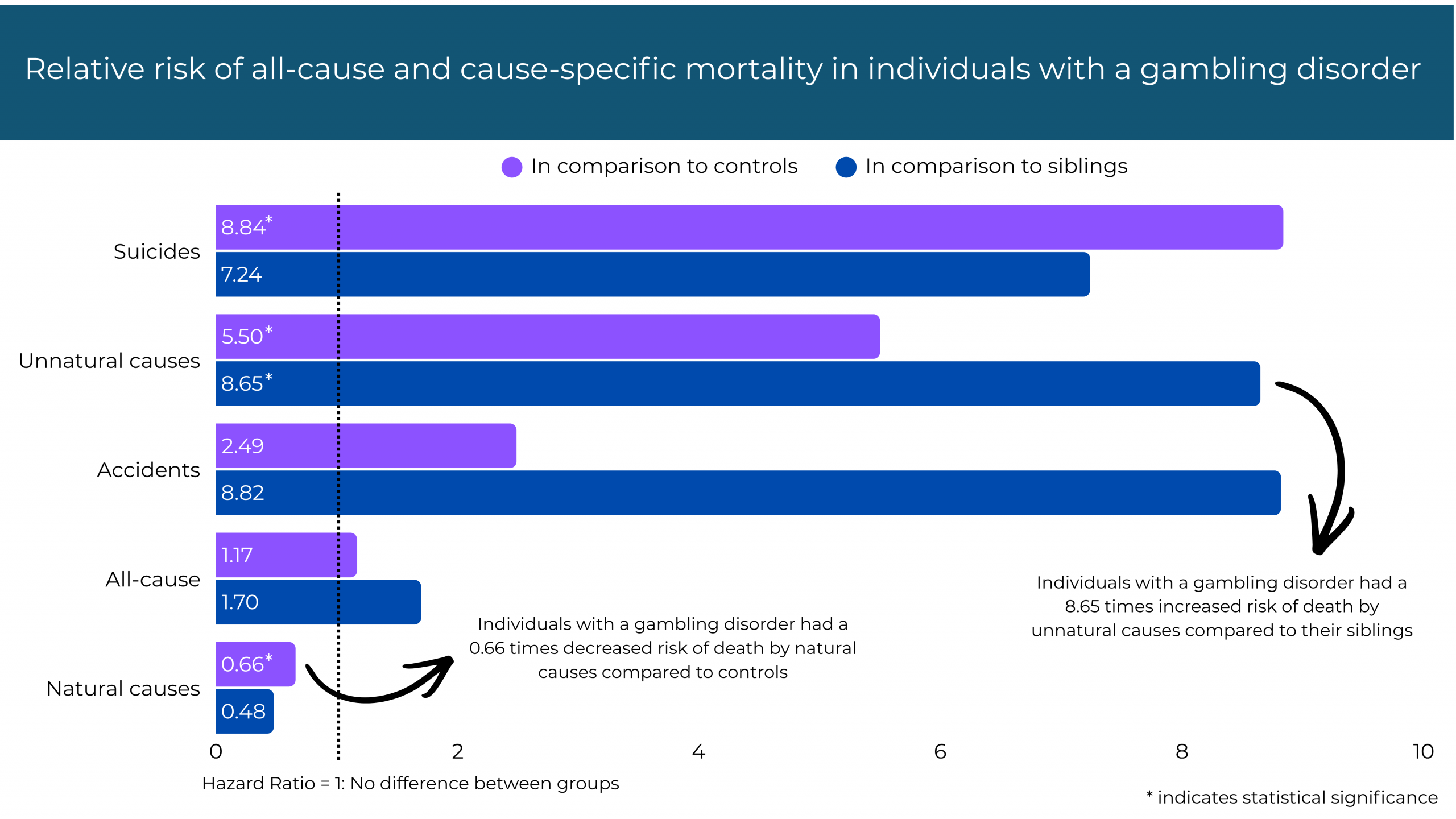
Figure. Hazard ratios for risk of all-cause and cause-specific mortality in individuals with a gambling disorder compared to controls and siblings, adjusted for relevant demographic and clinical covariates and missing data.
Why do these findings matter?
These findings emphasize that those affected by GD may be at greater risk for death by unnatural causes, especially suicide, even when accounting for other mental health problems. Those with GD or having problems with gambling should be screened for suicide risk and might benefit from education about suicidality as a potential consequence of problematic gambling. Due to the prevalence of co-occurring conditions, gambling treatment should be integrative and include screening/assessment for such conditions. Finally, gambling prevention initiatives and protections for emerging adults leaving the shared early-life environment and becoming more susceptible to gambling harms should be developed and tested.
Every study has limitations. What are the limitations in the study?
As this study was conducted on the Taiwanese population, external validity may be limited to other populations due to cultural context. While the results of the sibling comparison did result in one statistically significant finding, the small sample size of the sibling group does limit the statistical power of the analysis.